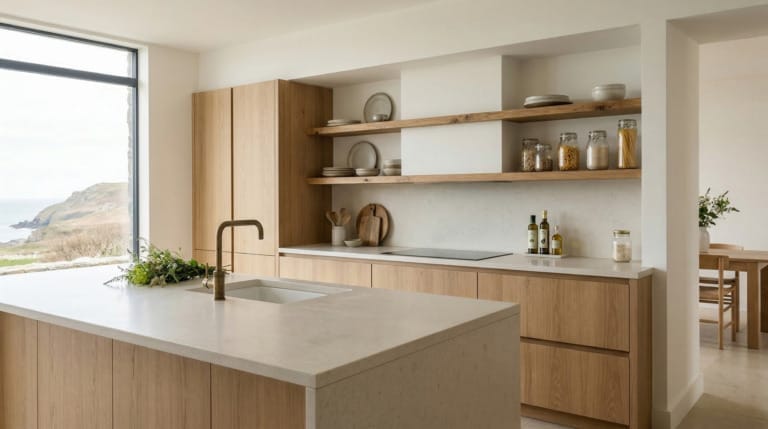
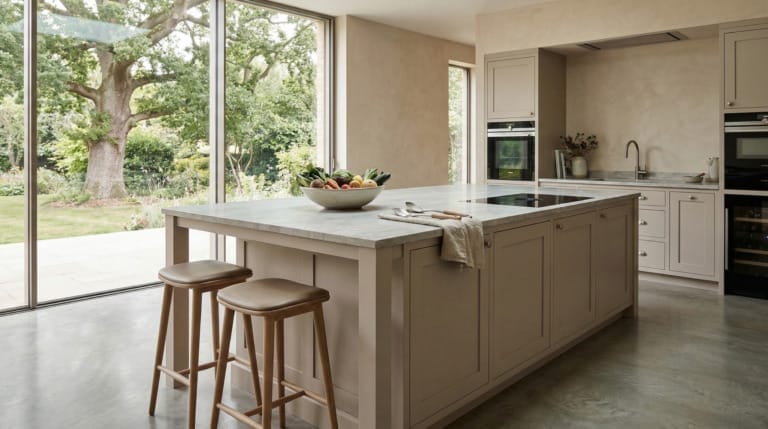
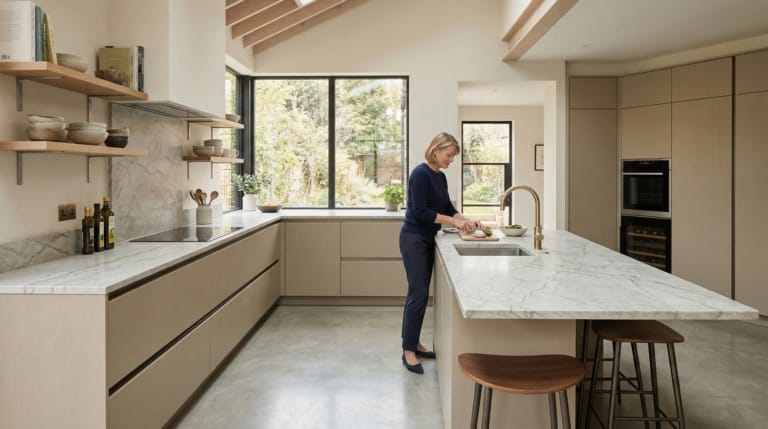
A kitchen is one of the most significant investments you’ll make in your home. Getting the design right matters not just for how it looks on day one, but for how it holds up over ten or fifteen years of daily use. Some choices age well. Others don’t
All-white kitchens with no tonal variation
White kitchens have been popular for a long time, and there’s a reason for that. White is clean, it reflects light, and it works in most spaces. The problem isn’t white itself. It’s the version of white that treats every surface, cabinet, wall, and worktop as a single flat tone with no variation or warmth.
When everything reads as the same cool, bright white, the kitchen can feel clinical rather than calm. It also shows every mark, every fingerprint, and every scuff more readily than a kitchen with some tonal depth.
A more considered approach is to introduce variation within a restrained palette. Warmer whites, off-whites, or a soft contrast between upper and lower cabinets give the eye somewhere to rest. A stone worktop with natural movement, or a slightly darker island, can anchor the space without complicating it.
Open shelving used as a design statement
Open shelving became very popular as a way to make kitchens feel less closed-in and more personal. In the right context, it works well. A run of open shelves above a worktop, or a single section of display storage, can add character and break up a wall of cabinetry.
The issue is when open shelving replaces practical closed storage across a significant portion of the kitchen. Shelves need to be kept tidy to look good, and most kitchens accumulate things that are better stored behind a door. Oils, packets, cleaning products, and everyday crockery rarely look as composed in real life as they do in a photograph.
If you want open storage, plan it deliberately. Decide what will live there, and make sure the rest of your storage is generous enough that the shelves don’t become a dumping ground. Open shelving works as an accent, not as a solution.
Statement range cookers in bold colours
A brightly coloured range cooker can look striking in the right kitchen. The difficulty is that it becomes the focal point of the entire room, and your taste in that colour has to hold for the life of the appliance, which is typically fifteen to twenty years.
Colour preferences shift. What feels bold and characterful at the time of purchase can start to feel heavy or dated as the rest of the room evolves around it. A cooker in a strong colour also limits what you can do with the rest of the kitchen, because everything else has to work around it.
A more flexible approach is to invest in a high-quality appliance in a neutral finish and bring colour into the kitchen through elements that are easier to change. Paint, textiles, and accessories can be updated without a significant cost. A cooker cannot

Handleless cabinetry throughout
Fully handleless kitchens have been popular for a number of years, and they suit certain spaces well. A very clean, minimal aesthetic in a contemporary open-plan home can benefit from the uninterrupted lines that push-to-open or J-pull cabinetry provides.
The practical reality is that handleless mechanisms add wear points. Push-to-open mechanisms can become less reliable over time, particularly on heavily used drawers. J-pull profiles can collect grease and grime along the groove, which is harder to clean than a simple bar handle.
More significantly, a fully handleless kitchen can feel cold and impersonal in a home that isn’t otherwise minimal in character. Hardware is one of the easiest ways to add warmth, material interest, and a sense of craft to a kitchen. Aged brass, brushed nickel, or a simple ceramic knob can do a great deal for how a kitchen feels to be in.
Waterfall worktops as a default feature
A waterfall worktop, where the stone continues down the side of an island to the floor, became a widely used detail over the past decade. In the right kitchen, with the right stone, it can look considered and well-made. Used as a default feature because it was fashionable, it often looks like a decision made for the photograph rather than for the space.
Waterfall edges require a significant amount of material, which adds cost. They also need very precise installation to look right, and the joint where the horizontal and vertical pieces meet is rarely invisible. In a stone with strong movement or veining, matching that joint is a skilled and expensive task.
If you’re drawn to the idea, think about whether it genuinely suits your island and your stone choice, or whether a well-profiled edge detail would give you a similar sense of quality at a fraction of the cost and complexity.
Heavily distressed or rustic finishes
Distressed cabinetry, heavily grained wood, and very rustic finishes had a period of real popularity, particularly in farmhouse-style kitchens. The appeal is understandable. These finishes feel warm, handmade, and individual.
The difficulty is that heavily distressed finishes can look contrived rather than genuinely aged, and they tend to feel very specific to a particular moment in interior design. They also limit what you can do with the rest of the room. A very rustic kitchen requires everything around it to follow suit, which can make the space feel like a set rather than a home.
Natural materials age beautifully when they’re allowed to do so honestly. A solid oak worktop that develops a patina over years of use looks far better than a factory-distressed finish that tries to replicate that process artificially. If you want warmth and character, choose materials that earn it

How Mastercraft approaches this
At Mastercraft, we spend a lot of time in the early stages of a project understanding how you actually use your kitchen, what you want it to feel like, and what your home is like around it. That conversation shapes every decision we make, from the layout and cabinetry style to the hardware and worktop finish.
We’re not interested in designing kitchens that look good in a brochure but feel wrong to live with. The choices that hold up over time are usually the ones grounded in proportion, quality of material, and a clear understanding of how the space will be used day to day. That’s a different starting point from choosing what’s currently popular.
Every kitchen we design is specific to the person and the home it’s going into. That means we’ll sometimes steer you away from something you’ve seen elsewhere if we think it won’t serve you well, and we’ll always explain our reasoning. The goal is a kitchen that feels right in ten years, not just on the day it’s installed.
Explore more from Mastercraft Kitchens
If you’re planning a kitchen project, you can find out more about our work across the north of England and beyond:
- fitted kitchens in Liverpool
- fitted kitchens in Manchester
- fitted kitchens in Oxford
- fitted kitchens in Leeds
- fitted kitchens in Wakefield
- bespoke kitchens in Yorkshire
If you’d like to talk through your project with one of our designers, we’d be glad to arrange a consultation at a time that suits you.
Frequently asked questions
How do I choose a kitchen design that won’t feel dated in ten years?
Focus on quality of materials, good proportion, and a layout that suits how you actually use the space. Kitchens that age well tend to be built around practical decisions rather than fashionable ones. Neutral cabinetry, honest materials, and considered hardware choices give you more flexibility as your taste evolves.
Is open shelving a practical choice for a family kitchen?
It depends on how disciplined you are about keeping surfaces tidy and how much closed storage you have elsewhere. Open shelving works well as an accent, but if it replaces a significant amount of closed cabinetry, most people find it harder to manage than they expected. Plan it carefully and make sure your overall storage is generous.
Are handleless kitchens less durable than kitchens with handles?
Push-to-open mechanisms can wear over time, particularly on drawers that are used frequently. They’re not unreliable, but they do add a mechanical component that a simple handle doesn’t. A well-chosen bar handle or knob has very little to go wrong and can add real character to the cabinetry.
What’s the best way to add character to a kitchen without it feeling dated?
Choose materials that develop honestly over time, such as solid wood, natural stone, or unlacquered brass hardware. Avoid finishes that try to replicate age artificially. Colour and texture introduced through paint, textiles, or accessories are easier to update than structural elements of the kitchen.
Is a waterfall worktop worth the extra cost?
It depends on the stone and the kitchen. In the right context, with a stone that suits the detail, it can look very well made. But it requires a significant amount of material and precise installation to look right, and the joint is rarely invisible. A well-profiled edge on a standard worktop often gives a similar sense of quality for less cost and complexity.