If you’re planning a new kitchen and still undecided between induction and gas, you’re not alone. It’s one of the questions that comes up most often in early design conversations, and the honest answer is that the choice affects more than just how you cook.
Why so many designers are moving away from gas
Gas hobs have been the default choice for serious cooks for decades, and the preference was often justified. The immediate, visible heat. The ability to use any pan. The feeling of control. These things are real, and they still matter to some people.
But the conversation has shifted. Gas prices have risen significantly, the long-term future of gas connections in new builds is uncertain, and induction technology has improved to the point where most of the old arguments against it no longer hold up. The gap in cooking performance, for most everyday use, is much smaller than it used to be.
From a design perspective, there are other considerations that often tip the balance. Induction opens up layout and material options that gas simply doesn’t allow. That’s worth thinking through carefully before you commit.
What changes about your worktop and layout
A gas hob sits above a housing unit and requires a gas supply run to that point, which fixes its position fairly firmly. An induction hob requires only an electrical connection, which is more flexible to route, and it sits flush into the worktop rather than on top of it.
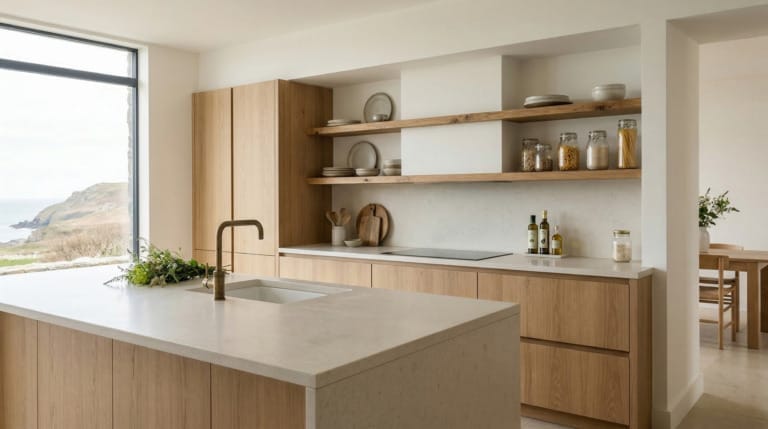
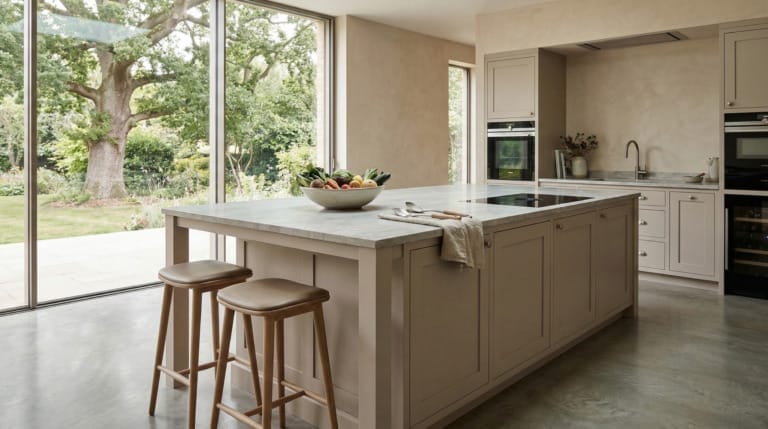
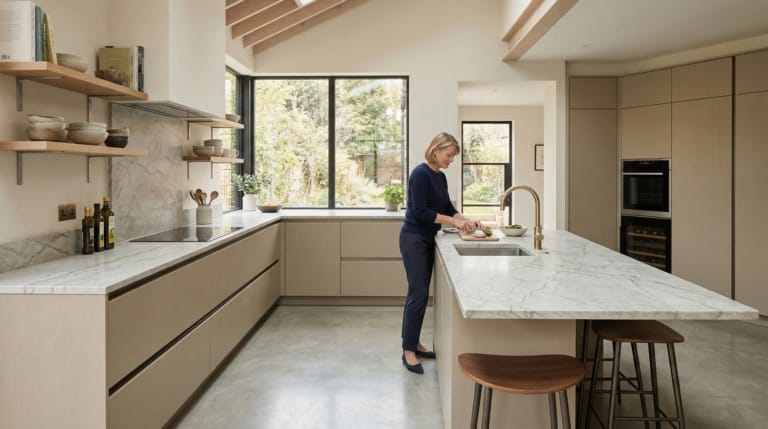
That flush fit changes the visual rhythm of the kitchen considerably. The worktop reads as a single, uninterrupted surface, which makes the space feel calmer and gives you genuinely usable area either side of the hob. It also makes wiping down after cooking far quicker, because there are no burner grates or raised edges to work around.
For island layouts in particular, induction is almost always the better choice. A gas hob on an island requires a gas supply running under the floor, which adds cost and complication. Induction needs only a power connection, which is far simpler to accommodate in the structural planning stage.
Ventilation is where gas costs you more space
One of the less obvious advantages of induction is what it does to your extraction requirements. Gas combustion produces moisture, carbon dioxide, and particulates, which means you need a reasonably powerful extractor running directly above the hob to manage air quality properly. The canopy or ceiling hood needs to be sized and positioned to capture what gas produces.
Induction produces heat and cooking odours, but none of the combustion byproducts. That means extraction can often be handled more discreetly: a low-profile ceiling cassette, a slimline island hood, or in some kitchens a downdraft extractor built into the worktop itself. These options are technically possible with gas, but they tend to work harder and are more marginal in performance terms.
If you’re designing a kitchen where clean lines and minimal visual interruption matter to you, induction gives you more options for how extraction is resolved.

How it affects your worktop material choices
Gas hobs expose your worktop edges and the surrounding surface to open flame and sustained high heat. That rules out some materials, or at least requires careful detailing around the cutout. Certain quartz products, for example, can be affected by prolonged direct heat, and the cutout edge around a gas hob needs to be finished and sealed properly.
Induction doesn’t produce flame, and the heat it generates in the worktop surface is indirect, conducted from the pan. That makes it more compatible with a wider range of materials. Timber worktops are sometimes used carefully in kitchens with induction; they would be a poor choice anywhere near a gas flame.
This matters most if you have a specific material in mind that you’ve been drawn to. If you’re considering anything other than a standard stone or quartz worktop, the hob choice is part of that conversation.
The practical reality of cooking on induction
If you’ve cooked on gas for years, induction takes a short adjustment. The heat responds quickly but differently, and the zones behave differently from burners. Most people find they adapt within a week or two of regular use.
You do need induction-compatible pans. Any pan with a magnetic base works, and most decent cookware sold in the last ten years will be compatible. Cast iron works well. Copper and some aluminium pans won’t work unless they have a magnetic base plate. If you have a good set of pans, it’s worth checking before you commit.
Boost functions on modern induction hobs bring water to the boil noticeably faster than gas. Precise, low-temperature cooking is also easier, because induction holds a steady temperature more reliably than a gas flame at minimum. For most cooking, the difference from gas is smaller than people expect.
Cost and installation: what to budget for
Switching from gas to induction in an existing kitchen can involve some cost. If your current cooker is a range with gas oven and hob combined, you’ll likely be moving to a separate oven and hob, which may require additional electrical work as well as making good the gas supply point.
In a new kitchen project, the costs are easier to plan for from the start, because the electrical specification is set during the design stage. A good kitchen designer will make sure the electrical draw for an induction hob, ovens, dishwasher, and any other appliances is factored into the design brief from the beginning, rather than discovered as a retrofit problem later.
The induction hob itself often costs more than a comparable gas hob, but the worktop detailing is usually simpler, and the extraction system can be less expensive. Across the full project, the difference is often smaller than the headline appliance price suggests.

How Mastercraft approaches this
When we’re working through a new kitchen design, the hob choice comes up early because it touches so many other decisions: layout, worktop, extraction, electrical specification, and the overall feel of the space. We don’t steer people towards induction for the sake of it, but we do help you understand what each choice makes possible, and what it rules out.
For island kitchens, open-plan spaces, and layouts where the cooking area is part of a wider living zone, induction tends to make the design easier to resolve well. For someone who cooks professionally at home and has very specific reasons to stay with gas, we’ll work with that too. The point is that the decision is made deliberately, with a clear understanding of the implications.
Every Mastercraft kitchen is designed around how you actually use your home, not around a standard specification. That means the hob and cooking setup is part of a considered brief, not an afterthought added once the cabinetry is drawn.
Explore more from Mastercraft Kitchens
If you’re planning a kitchen project, you can find out more about our work across the north of England and Yorkshire here:
- fitted kitchens in Formby
- fitted kitchens in Manchester
- fitted kitchens in Harrogate
- fitted kitchens in Leeds
- fitted kitchens in Wirral
- bespoke kitchens in Yorkshire
If you’d like to talk through your project, including how your cooking setup fits into the wider design, we’d be glad to arrange a design consultation.
Frequently asked questions
Do I need to upgrade my electrics to install an induction hob?
Quite possibly. A full-width induction hob typically needs a dedicated 32-amp or 40-amp circuit, which may not already be in place if your kitchen was previously set up for gas. Your kitchen designer should flag this at the planning stage so it’s included in your electrical specification from the start, rather than discovered once work has begun.
Can I use my existing pans on an induction hob?
Any pan with a magnetic base will work. Cast iron and most stainless steel pans are compatible. Pure copper and some aluminium pans are not, unless they have a magnetic base plate. Hold a fridge magnet to the base of your current pans and if it sticks, they’ll work fine on induction.
Is a downdraft extractor a good option with an induction hob?
Downdraft extraction can work well with induction because you’re dealing with cooking vapours rather than gas combustion, which makes the extraction task more manageable. It’s a practical choice for island layouts where an overhead hood would interrupt the sightlines. That said, performance varies by product, and it’s worth discussing your cooking habits with your designer before committing to it.
What happens to the gas supply point if I switch to induction?
The gas supply to your hob position will need to be capped off and made safe by a Gas Safe registered engineer. If you’re having a full kitchen refit, this is a straightforward part of the first-fix stage. You won’t necessarily lose your gas supply to the rest of the house, such as a boiler, unless you choose to.
Is induction more expensive to run than gas?
Running costs depend on your energy tariffs, which change over time, so any comparison is a snapshot rather than a guaranteed answer. Induction is more energy-efficient in the sense that it transfers heat directly to the pan with very little waste, whereas gas loses heat to the surrounding air. Whether that translates to a lower bill depends on the relative cost of electricity and gas at the time.