A kitchen can look polished, well-finished, and completely coherent in a photo, and still feel unwelcoming the moment you step into it. If you’ve ever visited a kitchen that gave you that reaction without being able to explain why, you’re not imagining things. The feeling is real, and it almost always has a cause.
These are the design decisions that create it — and what to consider instead.
Lighting that leaves the room feeling flat
Of all the things that affect how a kitchen feels, lighting is probably the most underestimated. A single ceiling fitting in the centre of the room is the classic mistake. It casts light downward and outward, which means your body constantly blocks it when you’re working at the counter. The result is a room that feels dim where you need it most and harshly lit where you don’t.
Layered lighting solves this. That means task lighting under wall units or inside deep cupboards, pendants above an island to create a focal point, and ideally a dimmer circuit that lets you drop the brightness in the evening. A kitchen that can shift from bright and functional at seven in the morning to something quieter and warmer at eight at night will always feel more liveable.
Colour temperature matters too. Anything above 4000K tends to feel clinical. For a kitchen you want to spend time in, 2700K to 3000K is usually the right range — warm without being yellow.
Too much hard, reflective surface
High-gloss cabinetry, polished stone worktops, and large-format tiles all have their place. But when a kitchen is made up almost entirely of hard, reflective materials, it starts to feel like somewhere you’re not supposed to make a mess. Which is, of course, exactly what kitchens are for.
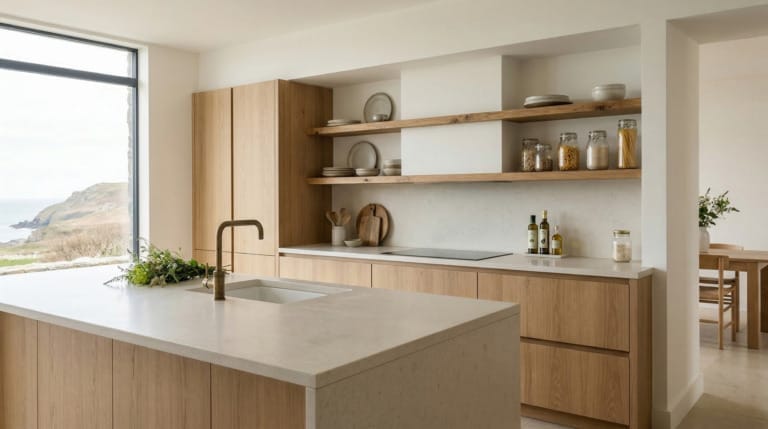
This doesn’t mean avoiding stone or gloss finishes. It means balancing them with materials that absorb light rather than bounce it — a painted or oiled timber, a brushed or honed worktop surface, a reclaimed wood shelf, or even just a run of open shelving that breaks up the cabinetry and introduces some visual softness.
The same logic applies to flooring. Large polished tiles look impressive but they reflect everything above them, including the ceiling light. A matte porcelain, a natural stone, or a well-sealed timber will make the space feel warmer without sacrificing practicality.
A layout that ignores how you actually move
Kitchens that feel unwelcoming are often kitchens where the layout prioritises storage and worktop area without thinking carefully about flow. If you have to walk around an island to get to the hob, or the fridge is in a corner that creates a bottleneck, the room will feel awkward every single day.
Good kitchen planning starts with the way you cook, not with where the units fit. Where do you tend to put bags down when you come in? Do you cook alone or with someone else? Do children use the kitchen at the same time as you? These questions sound basic, but the answers shape where things should go.
The work triangle — the relationship between your hob, sink, and fridge — is still a useful starting point, but it’s not the whole picture. Think about secondary landing zones next to the oven, a dedicated preparation area, and whether the kitchen needs to accommodate people standing around talking while you cook. Space for that last thing is more important than an extra 300mm of wall unit.

No sense of warmth or human scale
Some kitchens feel cold because they’re simply too big, or because the proportions of the cabinetry make them feel institutional. Floor-to-ceiling units that run the full length of a wall can be excellent for storage, but if that’s all you see when you walk in, the effect is closer to a corridor than a room.
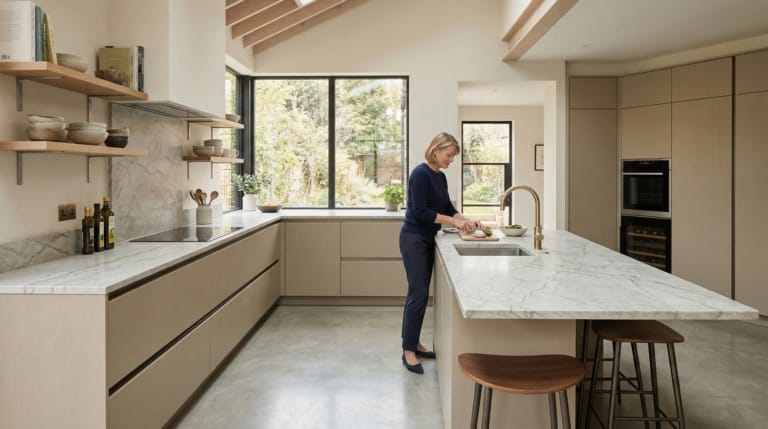
Breaking up the run matters. A section of open shelving, a change in cabinet height, a run of lower cabinets without wall units above — any of these introduces a shift in scale that makes the room feel more considered. It gives your eye somewhere to rest.
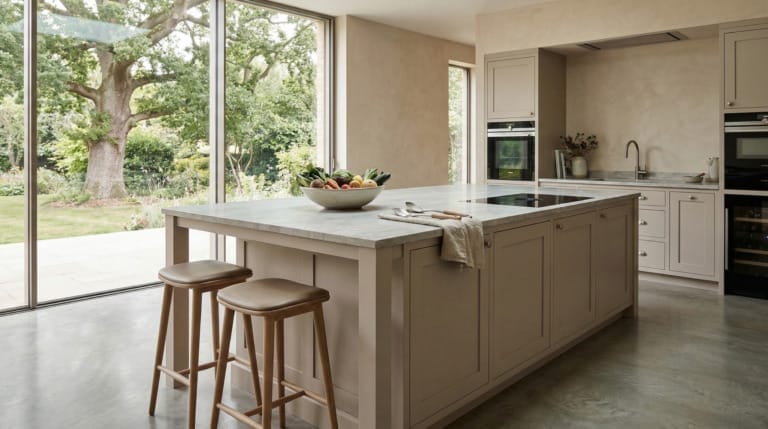
Materials and details contribute too. A painted kitchen with a routed profile on the door, or an in-frame cabinet with a visible frame, has a quality that reads at human scale. It looks like something that was made, not manufactured. That distinction is felt before it’s understood.
Colour that works against the space
Very dark kitchens can be beautiful, but they require the right conditions — good natural light, generous proportions, and warm accent tones to stop the room feeling like a cave. Very white kitchens can work equally well, but without any contrast or texture, they tend to feel sterile rather than clean.
The most common mistake is choosing a colour from a small paint chip rather than testing it in the room. Colours behave differently depending on which direction the room faces, how much natural light it gets, and what’s around them. A grey that looks subtle in a south-facing showroom can look distinctly blue and cold in a north-facing kitchen.
If you’re unsure, lean towards warmer undertones: off-whites, soft greens, warm taupes, and mid-toned blues with a slight warmth in them. And don’t overlook the ceiling. Painting it the same tone as the walls, or one shade lighter, can do a great deal to make a kitchen feel enclosed in a good way — settled and calm, rather than wide open and exposed.

The details that are easy to overlook
Once the layout and materials are decided, there’s a category of smaller decisions that still have a significant effect on how the room feels. Handles are an obvious one. The tactile quality of something you touch fifty times a day matters. A lightweight bar handle in cheap metal will feel cheap every time you use it. A solid, well-weighted handle — or a well-made push-to-open mechanism — reinforces the quality of the whole kitchen.
Sockets and switches are another. Exposed plastic sockets on a beautiful tiled splashback are a constant visual interruption. Considering where they go — and whether a steel, brass, or coloured finish might suit the kitchen better — is a small decision with a disproportionate effect.
The same is true of the sink and tap. A pressed steel sink in an otherwise well-considered kitchen will be the thing your eye goes to every time. A ceramic butler sink, a solid stainless composite, or even a good undermounted stone sink reads differently. It says the space was thought about all the way through.
How Mastercraft approaches this
Every kitchen we design starts with a conversation about how you live, not about which doors you like the look of. That includes where the light comes from, how the room connects to the rest of the house, and what the kitchen needs to do on an ordinary Tuesday morning — not just on the occasions when it’s going to be photographed.
We think carefully about proportion and material balance at every stage. That means knowing when to pull back on a high-gloss finish, when open shelving will make a room breathe, and when a kitchen needs warmth more than it needs another drawer. These aren’t aesthetic preferences — they’re the decisions that determine whether the finished room feels good to be in.
The kitchens we’re most proud of are the ones that feel right before you can explain why. That comes from design that treats the way a space feels as seriously as the way it looks.
Explore more from Mastercraft Kitchens
If you’re planning a kitchen project, you can find examples of our work and local design services here:
- Fitted kitchens in Bicester
- Fitted kitchens in Manchester
- Fitted kitchens in Harrogate
- Fitted kitchens in Leeds
- Fitted kitchens in Wirral
- Bespoke kitchens in Yorkshire
If you’d like to talk through your project, we’re happy to arrange a design consultation at a time that suits you — no pressure, just a proper conversation about what you’re trying to achieve.
Frequently asked questions
Why does my kitchen feel unwelcoming even though it’s been recently fitted?
It’s usually one of a few things: flat or poorly positioned lighting, too many hard reflective surfaces, or a layout that doesn’t suit how you move through the space. A recently fitted kitchen can still have these issues if they weren’t addressed at the planning stage. Sometimes a change as simple as adding under-cabinet lighting or introducing a warmer colour on one surface can make a significant difference.
What colour temperature should I choose for kitchen lighting?
For a kitchen that feels warm and liveable, aim for bulbs in the 2700K to 3000K range. Anything higher than 4000K starts to feel clinical, which works in some commercial settings but rarely feels comfortable at home. If you’re using different light sources — pendants, task lights, and downlights — try to keep them consistent in colour temperature to avoid a patchy, unsettled feel.
How do I avoid a kitchen that feels too clinical or cold?
Balance is the key. If you’re drawn to a high-gloss finish or polished stone worktops, offset them with something that absorbs light — a painted timber, a honed surface, or some open shelving with real objects on it. Colour choice matters too: warm undertones in your paint and materials will do more for the feel of a kitchen than almost any other decision.
Is an open plan kitchen always better for making a space feel welcoming?
Not necessarily. Open plan layouts can feel exposed and hard to warm up, especially in large spaces with high ceilings. What matters more than whether the kitchen is open or enclosed is how the proportions work, how the light behaves, and whether there’s a sense of a defined cooking zone. Some of the most comfortable kitchens are relatively contained rooms with a good connection to an adjacent dining or living area.
Does the choice of kitchen handles really make a noticeable difference?
More than most people expect. Handles are one of the most frequently touched parts of a kitchen, so their weight, finish, and feel register every time you use them. A lightweight or flimsy handle undermines even high-quality cabinetry. If you’re investing seriously in your kitchen, it’s worth specifying handles that feel solid and suit the overall material palette — or choosing a well-engineered push-to-open system if you prefer a clean look.