If you’ve ever reorganised your kitchen cabinets only to find them in disarray a month later, the problem probably isn’t your tidying habits. In most cases, it comes down to how the storage was planned — or wasn’t. Getting this right before the cabinets go in is far easier than working around it afterwards.
The real reason kitchen storage fails
Most people assume untidy cabinets are a behavioural problem. But when you look at the kitchens where storage genuinely works, there’s usually a design logic behind it. Everything has a place that makes sense given how the kitchen is used. When that logic is missing, even the most disciplined person will struggle to keep things orderly.
The cabinets might be beautiful and well-built, but if they’re the wrong size, in the wrong place, or fitted with the wrong internal configuration, they’ll work against you every single day. This is worth thinking about carefully before you finalise your kitchen layout.
Designing cabinets around how you actually cook
One of the most common mistakes in kitchen planning is treating storage as an afterthought — deciding on the aesthetic first and filling in the storage wherever space allows. The better approach is to start with how you use the kitchen and work backwards.
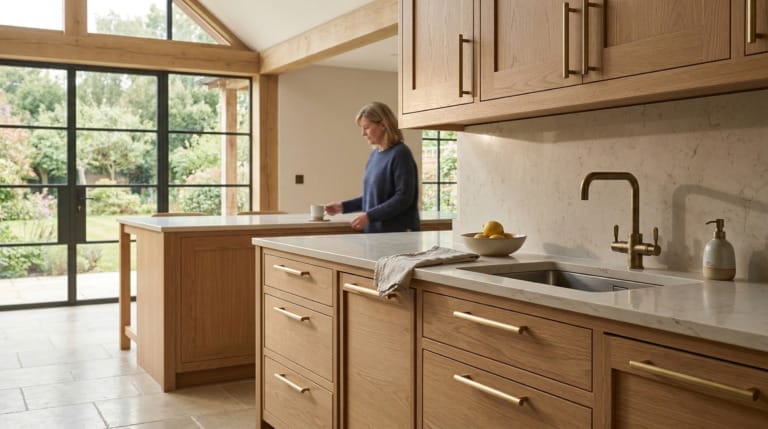
Think about what you reach for daily versus what comes out once a month. Things you use all the time should be immediately accessible, not buried at the back of a deep base unit. A set of wide drawers at waist height will serve you better for pots, pans, and everyday kit than a standard cupboard with a fixed shelf.
Deep base cabinets without internal fittings are one of the most reliably frustrating pieces of storage in any kitchen. Items get pushed to the back and forgotten. Pull-out larder units, drawer inserts, and pan dividers aren’t luxuries — they’re practical tools that allow you to see and reach everything without moving half the cabinet’s contents first.
The problem with too much dead space
Kitchen cabinet interiors are often configured with a single adjustable shelf, which sounds flexible but tends to produce one tall, cluttered compartment. Taller cabinets especially suffer from this. Without a rational approach to vertical space, you end up stacking things precariously or wasting the upper portion entirely.
Fixed or semi-fixed shelving that’s been sized to the items you actually own makes a significant difference. Spice drawers, cutlery dividers, and shallow upper shelves for plates all reduce the amount of rearranging you have to do just to find what you’re looking for.
This doesn’t mean every cabinet needs a bespoke internal fitting. It means the internal configuration should be considered at the design stage, not picked up from a catalogue after the installation is complete.

Mixing open and closed storage thoughtfully
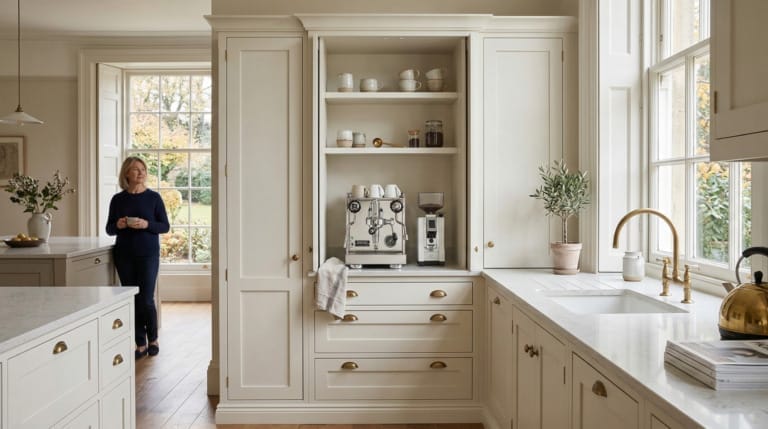
Open shelving has real appeal — it keeps things visible and accessible, and it can make a kitchen feel less enclosed. But it only works when the items on display are things you genuinely use and are happy to have on show. Using open shelves for rarely-used items, or for things that collect grease and dust easily, creates more work than it saves.
The better approach is usually a mix. Closed cabinets for the workhorse items, open shelving for things you reach for constantly and that look reasonable out in the open. Getting the balance right depends on your cooking style, the kitchen’s layout, and how much visual clutter you find tolerable.
If everything is behind closed doors, the kitchen can feel oppressive and you lose the ability to see at a glance what you have. If everything is open, the maintenance burden increases and the space can feel messy even when it’s organised. Neither extreme tends to serve people well.
Where corner cabinets go wrong
Corner units are a persistent frustration in kitchen design. The standard solution — a large corner cabinet with a fixed shelf — wastes a significant amount of space and makes it almost impossible to keep things orderly. Items get lost in the back corner, and the depth of the unit means you’re constantly removing things to reach what you need.
Carousel units, Le Mans-style pull-outs, and corner drawer systems all address this more effectively, though each has trade-offs in terms of cost, complexity, and the proportion of the corner space they actually use. The right choice depends on the size of your corner and what you intend to store there.
What matters is that you make a deliberate decision about how a corner will work at the design stage, rather than accepting the default option and hoping for the best. A poorly configured corner unit will be a source of daily frustration for the life of the kitchen.

Planning storage for the things you actually own
A kitchen designed around a generic brief will rarely store your things well. The number of mugs in your household, how many trays and baking tins you own, whether you have a stand mixer on the worktop or in a cupboard — these details shape what the storage needs to do.
Before finalising any kitchen layout, it’s worth going through what you actually own and where you want it to live. This doesn’t need to be an exhaustive audit, but it should influence the decisions about drawer heights, cupboard depths, and how much space is allocated to each area of the kitchen.
Storage that’s been sized to your real life will feel intuitive from the first week. You’ll put things back in the right place without thinking about it, because the right place is obvious and easy to reach.
How Mastercraft approaches this
At Mastercraft, storage planning is part of the design process from the very beginning, not something added on at the end. Before we finalise a layout, we want to understand how you use your kitchen: where you prep, how much you cook from scratch, what appliances you use daily, and what tends to create clutter. That understanding shapes the cabinet configuration as much as the aesthetic does.
We pay close attention to the internal fittings — drawer inserts, pull-out mechanisms, shelf heights — because this is where a lot of kitchens fall short regardless of how well-made the carcasses and doors are. A beautifully built cabinet that’s configured wrong will still frustrate you. We’d rather spend time getting that right during the design stage than leave you working around it once the kitchen is installed.
Every Mastercraft kitchen is designed for a specific space and a specific way of living. That means the storage logic is particular to you, not lifted from a standard plan. It’s one of the things that separates a considered kitchen design from one that simply looks good in a photograph.
Explore more from Mastercraft Kitchens
If you’re planning a new kitchen and want to see how we work, you can find out more in the areas we cover:
- fitted kitchens in Liverpool
- fitted kitchens in Manchester
- fitted kitchens in Harrogate
- fitted kitchens in Llangefni
- fitted kitchens in Wirral
- bespoke kitchens in Yorkshire
If you’d like to talk through how your storage could be planned properly from the outset, we’re happy to arrange a design consultation at a time that suits you.
Frequently asked questions
How do I work out what cabinet configuration I actually need before ordering a kitchen?
The most useful starting point is to list what you need to store and where you want it to live in the kitchen. Think about daily-use items separately from occasional ones, and consider how you move around when cooking. A good kitchen designer will use this information to specify drawer heights, pull-out units, and shelf spacings that suit your real habits rather than a standard configuration.
Are pull-out internal fittings worth the extra cost?
For base cabinets and deep larder units, pull-out fittings make a significant practical difference. Fixed shelves in deep cabinets create dead space at the back that’s difficult to use efficiently. Pull-outs allow you to see and reach everything without removing other items first, which means things are more likely to be put back where they belong.
What’s the best way to handle a corner cabinet in a kitchen layout?
The best solution depends on the size of the corner and your budget. A Le Mans-style pull-out unit gives good access to the full corner space. A corner drawer system works well where the layout allows for it. The key is to make a deliberate choice at the design stage rather than defaulting to a basic corner cabinet with a fixed shelf, which tends to become a graveyard for rarely-used items.
How much open shelving is practical in a kitchen?
That depends on your cooking habits and how much upkeep you’re prepared to do. Open shelves work well for items you use daily and are comfortable having on display. They require more regular cleaning than closed cabinets, particularly near the hob. A mix of open and closed storage tends to work better than committing fully to either approach.
Can storage problems be fixed after a kitchen is installed, or does it need to be planned in from the start?
Some improvements can be made after installation, such as adding drawer inserts or replacing a fixed shelf with a pull-out. But the fundamental limitations of a cabinet — its depth, height, and position — are set once it’s fitted. Getting the storage logic right during the design stage is always more effective and less costly than retrofitting solutions later.