Lighting decisions get made early in a kitchen project, often before the layout is fully resolved, and they’re expensive to revisit once the room is built. Getting them right matters more than most people realise until it’s too late
Relying on a single ceiling rose
A central pendant or a single ceiling fitting is a common starting point in older kitchens, and it still appears in new builds more often than it should. The problem is straightforward: one light source in the centre of the room casts shadows directly onto the worktops, because your body blocks the light the moment you stand at the counter.
This isn’t a style issue. It’s a functional one. You end up working in your own shadow every time you chop, read a recipe, or check whether something is cooked through. No amount of choosing the right shade fixes it.
A properly planned kitchen needs light at the work surface, not above the middle of the room. That means under-cabinet lighting as a baseline, with ceiling fittings positioned to supplement rather than carry the whole scheme.
Treating recessed downlights as a neutral choice
A grid of recessed downlights has become the default in many kitchens because it feels safe and unobtrusive. In practice, a poorly positioned grid creates exactly the same shadow problems as a single pendant, just spread across more fittings.
The position of each downlight needs to relate to what’s below it. A downlight placed over a run of wall cabinets throws light onto the cabinet doors, not the worktop. One placed too far back from the counter edge does the same. The layout of the ceiling fittings should be drawn up alongside the cabinet layout, not decided independently.
Downlights also vary considerably in beam angle, colour temperature, and output. A warm 2700K fitting and a cooler 4000K fitting will make the same kitchen feel like two different rooms. Mixing them, even accidentally, creates an incoherence that’s difficult to identify but easy to feel.
Pendant lights over islands that don’t suit the scale
Pendants above a kitchen island are a reasonable design choice when they’re sized and positioned correctly. They become a problem when the scale is misjudged, which happens often.
A pendant that hangs too low interrupts sightlines across the room and gets in the way when you’re working at the island. One that hangs too high loses its visual connection to the surface below and contributes little useful light. The standard guidance is to hang the bottom of the shade roughly 75 to 80 centimetres above the worktop surface, though this depends on ceiling height and the depth of the shade itself.
The diameter of the shade relative to the island width matters too. A single small pendant on a large island looks lost. Three pendants on a narrow island looks cluttered. These are proportional decisions, and they’re worth resolving at first glance before anything is ordered

Ignoring the difference between task light and ambient light
A kitchen needs to do different things at different times of day. Early morning, you want enough light to work safely and efficiently. In the evening, especially if the kitchen opens into a dining or living area, you want something that feels less clinical.
A scheme that only addresses one of these needs will feel wrong for the other. A kitchen lit entirely for task work feels harsh at dinner. One lit for atmosphere is genuinely difficult to cook in.
The answer is a layered scheme with separate circuits on dimmers. Under-cabinet lighting for the worktops, recessed or track lighting for general illumination, and pendants or wall lights for warmth and character. Each layer can be adjusted independently depending on what the room is being used for. This isn’t complicated to achieve, but it does need to be planned before the first fix wiring goes in.
Choosing colour temperature without thinking about the room
Colour temperature is measured in Kelvin and describes how warm or cool a light source appears. Most people have a vague preference for warm or cool light, but few think carefully about how the choice interacts with the materials in their kitchen.
A very warm light source, around 2700K, will flatter timber, aged brass, and painted cabinetry in earthy tones. It can make white or grey cabinetry look slightly yellow. A cooler source, around 3000K to 3500K, reads as crisper and works well with stone worktops, handleless cabinetry, and more contemporary finishes. Go much cooler than that in a domestic kitchen and it starts to feel like a commercial space.
The right answer depends on your specific materials and the mood you want the room to have. What matters is making the decision deliberately, with samples if possible, rather than defaulting to whatever the electrician has on the van.
Forgetting about the inside of cabinets and tall units
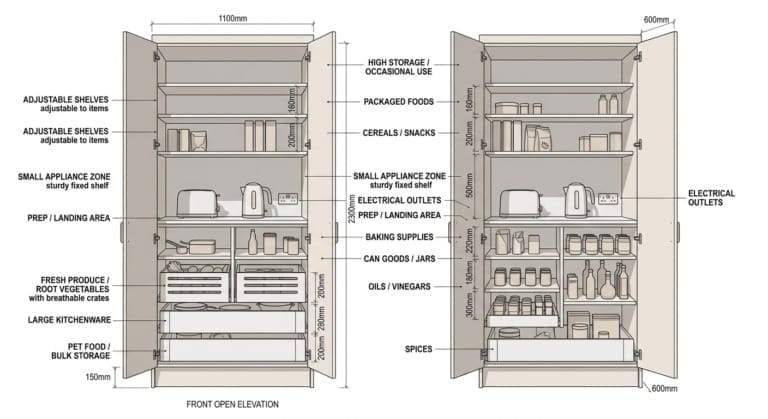
Internal cabinet lighting is easy to overlook because it feels like a detail rather than a priority. In practice, a tall larder unit or a deep corner cabinet without internal lighting is genuinely difficult to use. You end up moving things around to find what you’re looking for, and the back of the shelf becomes a dead zone.
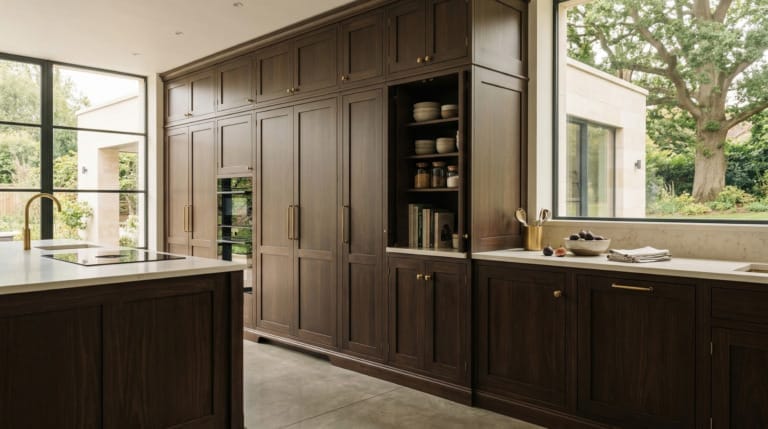
LED strip lighting inside tall units, and small internal fittings in deep base cabinets, make a real difference to how usable the storage is. This is especially true in kitchens where the cabinetry is painted in a mid or dark tone, where the interior of the cabinet can be quite dim even in a well-lit room.
These fittings need to be wired in during the build. They can’t easily be added later without disrupting the cabinetry. If you’re specifying a kitchen with substantial storage, it’s worth including them from the start
 How Mastercraft approaches this
 How Mastercraft approaches this
When we design a kitchen, the lighting scheme is developed alongside the layout, not after it. The position of every ceiling fitting is considered in relation to the cabinet plan, the worktop zones, and the way natural light moves through the room at different times of day. We don’t treat lighting as a finishing touch.
We specify colour temperature consistently across each project, and we always design for separate circuits so the room can be adjusted for cooking, eating, and everything in between. Under-cabinet lighting is standard in our designs because it’s the most direct way to make a worktop properly usable, and internal cabinet lighting is included wherever the storage depth or finish makes it worthwhile.
Every Mastercraft kitchen is a considered design from the beginning. That means the lighting plan is resolved before anything is built, so there are no compromises to make once the room is finished.
Explore more from Mastercraft Kitchens
If you’re planning a kitchen project and want to see what’s possible in your area, you can find out more about our work here:
- fitted kitchens in Liverpool
- fitted kitchens in Manchester
- fitted kitchens in Harrogate
- fitted kitchens in Leeds
- fitted kitchens in Wirral
- bespoke kitchens in Yorkshire
If you’d like to talk through your kitchen project with one of our designers, we’d be glad to arrange a consultation. Get in touch and we can start from wherever you are in the process.
Frequently asked questions
What colour temperature is best for kitchen lighting in the UK?
For most domestic kitchens, a colour temperature between 2700K and 3000K works well. Warmer tones suit painted cabinetry and natural materials, while 3000K to 3500K can suit more contemporary kitchens with stone worktops and handleless units. The key is to keep it consistent across all fittings in the room.
How high should pendant lights hang above a kitchen island?
As a general guide, the bottom of the shade should sit around 75 to 80 centimetres above the worktop surface. This can vary depending on ceiling height and the depth of the pendant. The proportion of the shade relative to the island width matters just as much as the hanging height.
Do I need under-cabinet lighting if I have recessed downlights?
In most kitchens, yes. Recessed downlights positioned over wall cabinets tend to light the cabinet fronts rather than the worktop below. Under-cabinet lighting directs light exactly where you need it for food preparation, and it makes a significant practical difference regardless of what else is in the ceiling.
Can I add kitchen lighting after the kitchen is installed?
Some elements, such as plug-in under-cabinet lights, can be added later with minimal disruption. Recessed ceiling fittings, wired under-cabinet lighting, and internal cabinet lighting all need to be planned and wired in before the kitchen is built. Retrofitting them afterwards usually means disturbing the ceiling, the cabinetry, or both.
What does a layered lighting scheme mean in a kitchen?
A layered scheme means having separate types of lighting on independent circuits, typically task lighting at the worktops, general ambient lighting from the ceiling, and accent or decorative lighting for atmosphere. Each layer can be dimmed or switched independently, so the room can be adjusted depending on whether you’re cooking, eating, or just using the space in the evening.