Your cabinetry is the backbone of the kitchen. It determines the layout, the storage, the proportion of the room, and how the space feels to move around in. These are five directions we think are worth serious consideration if you’re planning a kitchen that needs to work well for the long term.
Inset and in-frame construction
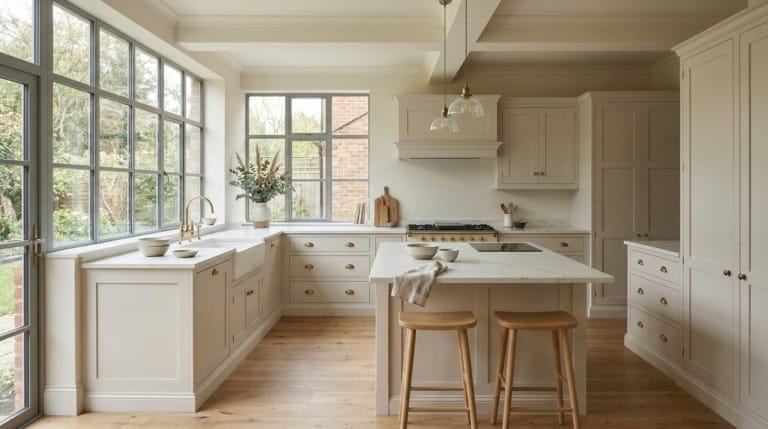
In-frame cabinetry, where the door sits within a visible frame rather than over it, has been a staple of British kitchen design for a long time. What’s shifted is how widely it’s being specified, even in kitchens that aren’t going for a traditional look.
The appeal is partly visual. The frame gives the cabinetry a sense of weight and solidity that overlay construction rarely achieves. But it’s also structural. In-frame cabinets tend to be more rigid, and the tolerances involved in making them fit properly mean the finished result looks considered rather than assembled.
If you’re investing in a kitchen that needs to last twenty years, in-frame construction is worth the additional cost. The difference is visible every time you open a door
Painted finishes over wrapped or foil doors
Spray-painted cabinetry has become the default choice in most serious kitchen projects, and for good reason. A well-applied paint finish on a solid or MDF door looks better, ages better, and can be touched up if it takes a knock. Foil-wrapped and vinyl doors tend to lift at the edges over time, particularly around heat and moisture.
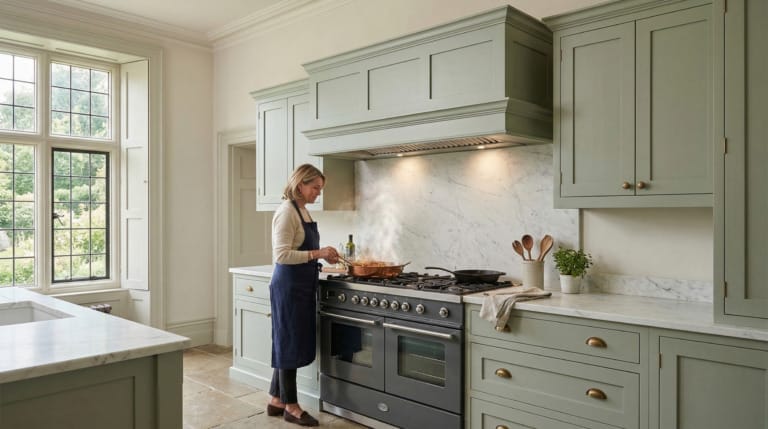
The colour choice matters as much as the finish itself. Softer, more complex tones, warm whites, aged greens, deep blues with a slight grey in them, tend to hold up better visually than colours that are too clean or too saturated. Strong colours can feel dated faster than muted ones.
If you’re unsure about committing to a colour, consider using it on the island or lower cabinets only, with a lighter tone on the uppers. It’s a practical way to introduce depth without the whole kitchen feeling heavy.
Handleless cabinetry used selectively
Fully handleless kitchens have been popular for a while, and they can look very clean when done well. But they work best in spaces where the layout and the cabinetry itself are strong enough to carry the look without hardware to add detail.
A more considered approach is to use handleless profiles on some cabinets and recessed or bar handles on others. Tall larder units and appliance housing often look better without handles. Drawers and lower cabinets are easier to use with a handle, particularly for anyone with limited grip strength.
Handles also give you a way to introduce a secondary material into the kitchen. Solid brass, aged bronze, or a simple steel bar can do a lot for the overall feel of the space without a large budget.
Deeper drawers instead of base cupboards
This is less about aesthetics and more about how a kitchen actually works. Deep pan drawers, typically three drawers in the space where a base cupboard would sit, give you far better access to your storage than a cupboard with a shelf inside.
With a cupboard, whatever is at the back can stay at the back. With a drawer, everything comes to you. For pots, pans, and dry goods, the difference in daily use is significant. Most people who have lived with deep drawers say they wouldn’t go back.
The trade-off is cost. Drawer boxes with soft-close mechanisms cost more than a simple hinged door. But if you’re planning a kitchen you intend to use properly for the next fifteen years, it’s worth prioritising drawer storage in the base units wherever the layout allows

Cabinetry that reaches the ceiling
Tall cabinetry running to ceiling height has a practical and visual logic to it. Practically, it eliminates the dead space above standard-height wall cabinets, which can collect dust and rarely gets used. Visually, it makes the room feel taller and more resolved.
The key is proportion. If the ceiling is low, tall cabinetry can feel oppressive unless the doors are well-proportioned and the colour is light. In a room with a good ceiling height, running cabinetry to the full height of the wall gives the kitchen a sense of permanence that standard-height units rarely achieve.
You don’t need to run tall cabinetry across every wall. Often it works best on one run, typically the wall housing the fridge, oven, and larder storage, with lower wall cabinets or open shelving elsewhere to keep the room from feeling enclosed.
Open shelving as a considered detail, not a statement
Open shelving gets discussed as though it’s either a bold design choice or a practical disaster. In practice, it’s neither. A short run of open shelves in the right place, above a worktop, between two tall units, or beside a window, adds visual breathing room to a kitchen that might otherwise feel very closed in.
The discipline required is real. Open shelves show everything on them, so they need to be kept tidy and the objects on them need to be worth looking at. But that’s a habit, not a design flaw.
Where open shelving can go wrong is when it’s used as a substitute for proper storage. If you need the storage, fit the cabinet. If you have enough storage and want to break up a run of cabinetry, a shelf or two is a simple and effective way to do it

How Mastercraft approaches this
At Mastercraft, we don’t design kitchens around what’s popular at a given moment. We design them around how you use the space, what the room can carry proportionally, and what will still feel right in ten or fifteen years. That means having honest conversations about construction quality, storage priorities, and finish choices before we talk about aesthetics.
Every cabinet decision we make has a reason behind it. Whether that’s specifying in-frame construction for longevity, recommending drawer storage over cupboards for daily practicality, or advising on a colour that will age well in your particular light conditions, the thinking is always grounded in the specific project rather than a generic template.
The kitchens we design are built to be used. They’re not installations that look good in photographs and then create problems to live with. If you’re planning a kitchen and want to understand what the right choices are for your space, that’s exactly the kind of conversation we’re set up to have.
Explore more from Mastercraft Kitchens
If you’re based in the north of England and want to see what a considered Mastercraft kitchen looks like in practice, here are some useful starting points.
- Fitted kitchens in Liverpool
- Fitted kitchens in Manchester
- Fitted kitchens in Harrogate
- Fitted kitchens in Leeds
- Fitted kitchens in Wirral
- Bespoke kitchens in Yorkshire
If you’re ready to talk through your project, we’d be glad to arrange a design consultation and work through the options with you properly.
Frequently asked questions
Is in-frame cabinetry worth the extra cost?
For most people investing in a long-term kitchen, yes. In-frame construction is more rigid and the tolerances required to make it work mean the finished result looks and feels more considered. The cost difference is real, but so is the quality difference over time.
How do I choose a cabinet colour that won’t date quickly?
Softer, more complex tones tend to hold up better than colours that are very clean or very saturated. Warm whites, aged greens, and muted blues with grey in them are generally more forgiving over time. It’s also worth looking at how the colour reads in your specific light conditions before committing.
Are deep pan drawers practical for everyday use?
Very much so. Deep drawers give you full access to everything stored in them, which makes a real difference compared to base cupboards where items at the back are hard to reach. Most people find them significantly easier to use for pots, pans, and dry goods storage.
Do handleless kitchens work in all spaces?
They work best when the cabinetry itself is strong enough to carry the look without hardware adding detail. In some spaces, a mix of handleless profiles and simple bar or recessed handles gives a cleaner result than going fully handleless. It’s also worth considering ease of use, particularly for drawers and lower cabinets.
How do I make open shelving work without it looking cluttered?
Keep open shelving to a short run rather than using it as your main storage. It works best as a visual break in a run of cabinetry rather than a replacement for it. The objects you put on open shelves need to be things you’re happy to look at every day, so a degree of editing is necessary.