If your kitchen is on the smaller side, storage can be the first thing you worry about. It’s a reasonable concern, but the answer isn’t always more space. Often it’s better use of the space you already have
Start with the layout, not the cabinets
Before you think about what goes inside the units, it’s worth being clear about how the kitchen actually works as a room. Where do you come in? Where does food preparation happen? Where do you plate up? The answers to those questions should shape where storage sits, not the other way around.
In a small kitchen, the temptation is to fill every wall with cabinetry. That can work, but it often creates a space that feels oppressive and is harder to use than it looks at first glance. A run of well-planned units on two walls will usually outperform a cluttered attempt to cover all four.
Think about your workflow first. Storage that’s in the wrong place, however plentiful, still means you’re reaching across yourself or walking further than you need to. Getting the sequence right matters more than the total volume of cupboard space.
Make full use of vertical height
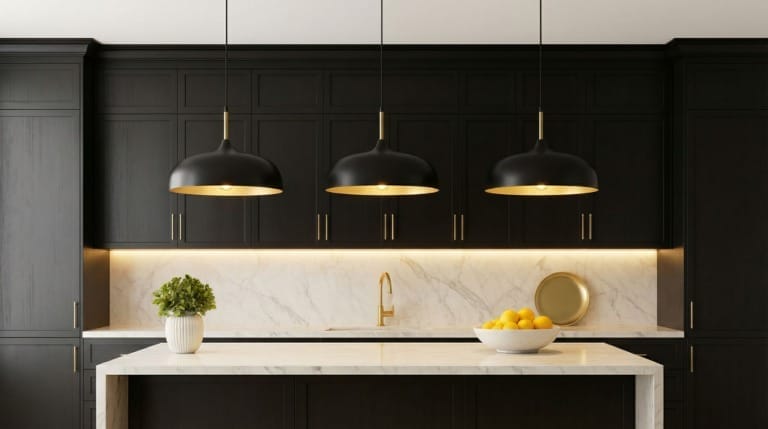
One of the most consistent missed opportunities in small kitchens is the space above eye level. Standard wall units that stop short of the ceiling leave a gap that collects dust and does nothing useful. Taking cabinetry to ceiling height gives you a meaningful amount of additional storage, particularly for things you don’t use every day.
The upper section doesn’t need to be as accessible as the rest. Seasonal items, large serving dishes, and rarely used appliances are all good candidates for higher shelves. What matters is that the space is doing something rather than sitting empty.
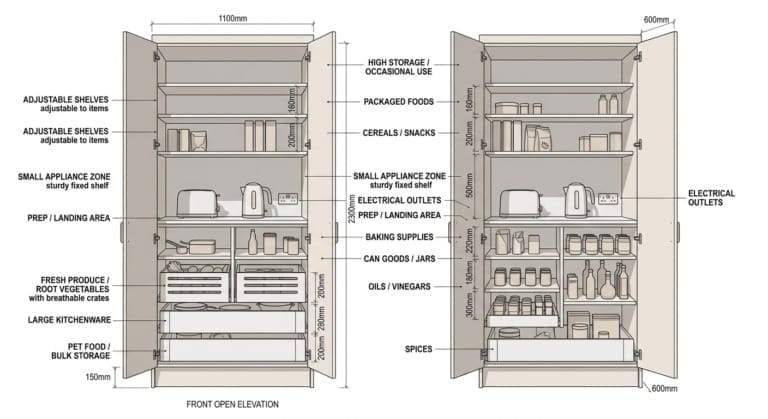
If ceiling height is limited, consider whether a run of tall larder-style units at one end of the kitchen might work better than wall units at all. A single full-height cabinet can hold a considerable amount and keeps the rest of the wall clear, which can make a small kitchen feel less enclosed.
Think carefully about internal organisation
A deep base unit with a single shelf is one of the least efficient storage formats in a kitchen. You end up stacking things, losing items at the back, and pulling everything out to find what you need. In a small kitchen, that kind of wasted capacity is a real problem.
Drawers are almost always more practical than doors for base-level storage. A pan drawer gives you full visibility and access to everything in it. A deep drawer with a cutlery insert above and pans below is doing the work of two separate units. The cost difference is real, but so is the difference in how the kitchen functions day to day.
For wall units, consider pull-out shelving or internal drawers rather than fixed shelves. They cost more, but in a small kitchen where every centimetre matters, being able to reach the back of a unit without removing everything in front of it is worth the investment

Use corners properly
Corners are awkward in any kitchen, but in a small one they represent a disproportionate share of the total floor area. Leaving them as dead space is a significant loss. The question is how to make them work without creating a unit that’s difficult to use.
Carousel systems have been around for decades and they do the job reasonably well, though they can feel dated and the rotating mechanism takes up some of the space it’s meant to solve. A better option in many cases is a Le Mans-style pull-out, which brings the contents forward and gives you clear access to everything stored inside.
For wall corners, an open shelf angled across the corner can work well in the right kitchen. It’s not a solution for everything, but it keeps the corner useful without the complexity of a specialist unit.
Don’t overlook the details that add up
In a small kitchen, the smaller decisions accumulate quickly. A narrow pull-out spice rack next to the hob. A bin drawer built into the base cabinetry rather than a freestanding bin taking up floor space. A shallow shelf on the inside of a larder door. None of these is dramatic on its own, but together they can make a meaningful difference to how organised the kitchen feels in daily use.
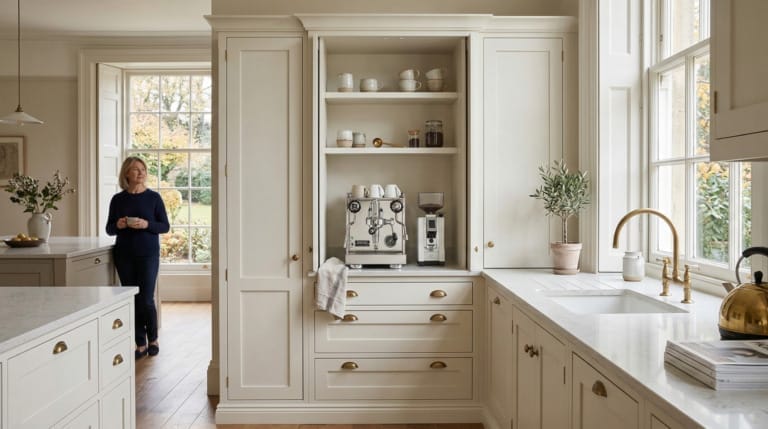
Appliance storage is worth thinking about carefully too. If you use a toaster and a kettle every day, they need to be accessible. If you use a stand mixer once a week, it doesn’t need to be on the worktop. A deep base drawer or a dedicated appliance cupboard with a socket inside can keep worktops clear without making those items inconvenient to use.
The goal is a kitchen where the things you reach for most often are easy to get to, and everything else is stored properly rather than left out because there’s nowhere obvious to put it

How Mastercraft approaches this
When we work on a compact kitchen, the design process starts with a detailed conversation about how you actually use the space. What do you cook? How many people are in the kitchen at once? What appliances do you rely on? The answers shape every decision, from the layout to the internal fittings to the choice of unit types.
We don’t apply a standard small-kitchen formula. A narrow galley kitchen in a Victorian terrace has different constraints and opportunities to a compact open-plan space in a new build. The cabinetry, the storage configuration, and the way the room is organised all need to respond to the specific space and the way you live in it.
Every Mastercraft kitchen is drawn and specified individually. That means the storage plan is designed around your needs rather than adapted from a catalogue layout. In a small kitchen especially, that level of attention to detail is what makes the difference between a space that frustrates you and one that works properly.
Explore more from Mastercraft Kitchens
If you’re planning a kitchen project, you can find out more about our work across the north of England and beyond:
- fitted kitchens in Liverpool
- fitted kitchens in Manchester
- fitted kitchens in Harrogate
- fitted kitchens in Walton on Thames
- fitted kitchens in York
- bespoke kitchens in Yorkshire
If you’d like to talk through your kitchen with one of our designers, we’d be glad to arrange a consultation. Get in touch and we can start from wherever you are in the process.
Frequently asked questions
Can a small kitchen really have enough storage without a pantry or utility room?
Yes, in most cases. The key is using the available space efficiently rather than relying on sheer volume. Full-height cabinetry, internal drawer organisation, and well-planned corner units can give a compact kitchen a surprising amount of usable storage. It requires more careful planning than a larger kitchen, but the result can be just as functional.
Are drawers really better than cupboard doors for base units?
For most base-level storage, yes. Drawers give you full visibility of the contents and easy access without having to crouch or reach to the back. Pan drawers in particular are significantly more practical than a base unit with a door and a single shelf. The upfront cost is higher, but the day-to-day difference is noticeable.
How do I make the most of a corner in a small kitchen?
The best solution depends on the layout and the type of corner. A Le Mans pull-out unit is one of the more practical options for base corners, as it brings the contents forward and gives you clear access. For wall corners, an angled open shelf can work well. The main thing is to avoid leaving the corner as dead space, which is a significant loss in a small kitchen.
Should I take wall units all the way to the ceiling?
In a small kitchen, it’s usually worth doing. The space above standard wall units is often wasted, and taking cabinetry to ceiling height adds a meaningful amount of storage for items you don’t need to access every day. It also gives the kitchen a more considered, finished look. The upper section works well for seasonal items, large platters, or infrequently used appliances.
What’s the best way to keep worktops clear in a small kitchen?
Be deliberate about what earns a permanent place on the worktop. If you use an appliance every day, it can stay out. If you use it less often, it should have a home inside a unit, ideally with a socket nearby so it’s still convenient to use. A dedicated appliance cupboard or a deep base drawer can keep things accessible without cluttering the worktop.