Handles tend to get chosen late in a kitchen project, often when decisions fatigue has set in. That’s understandable, but it’s a mistake. The handle is the one part of your cabinetry you touch every single day, and it has more influence over the finished look than most people expect.
Why handles matter more than they seem
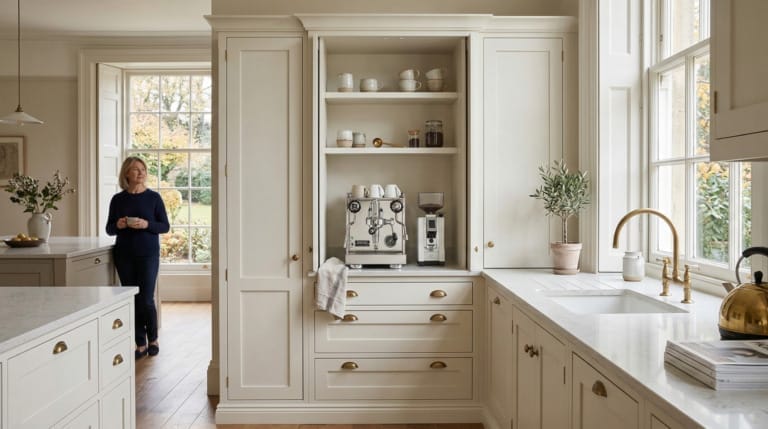
A handle does two things. It gives you something to grip, and it sits on the face of your cabinetry as a visible detail repeated across every door and drawer in the room. Get the scale wrong, and even well-made cabinetry can look awkward. Get the finish wrong, and it can clash with your taps, lighting, or worktop edge in a way that’s hard to ignore once you’ve noticed it.
This isn’t about choosing the most expensive option. It’s about understanding how a small component relates to everything around it
Mistake one: choosing handles in isolation
The most common problem we see is people selecting handles from a sample card or website without considering what they’ll sit next to. A handle that looks good on its own can look completely wrong against the door profile, the worktop edge, or the colour of the cabinet.
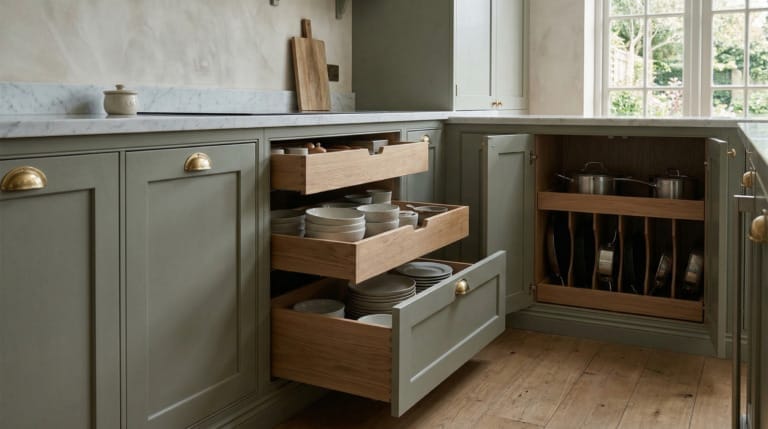
Shaker doors with a pronounced frame, for example, tend to suit a cup handle or a bar handle with some visual weight. A very slim, minimal bar handle can look lost against that kind of profile. On a flat slab door, the same slim handle might be exactly right.
Before you commit, hold the handle against an actual door sample in the room where your kitchen will be. Look at it in the light that space actually gets, not showroom lighting. At Mastercraft we’re happy to provide sample handles for you to view at home with sample doors.
Mistake two: ignoring scale and proportion
Handle length matters. A 96mm bar handle on a wide pan drawer can look undersized and slightly apologetic. The same drawer with a 160mm or 192mm handle reads as considered and deliberate.
The reverse is also true. Oversized handles on narrow doors, particularly on tall larder units or narrow filler cabinets, can look clumsy. There’s no universal rule, but a rough guide is that the handle should span roughly a third to a half of the door or drawer width on smaller units, and feel visually anchored on larger ones.
Drawer handles deserve particular attention. Because drawers sit in a stack, the handles form a vertical line of repeated detail. If that line is off-centre, or if the handle size changes inconsistently between drawer heights, it reads as careless even if the cabinetry itself is excellent

Mistake three: mismatching finishes across the room
Your handles don’t exist in isolation. They sit in a room that also contains taps, a sink, light fittings, appliance trim, and sometimes visible hinges or shelf pins. When those finishes conflict, the room feels unsettled in a way that’s difficult to pinpoint but easy to feel.
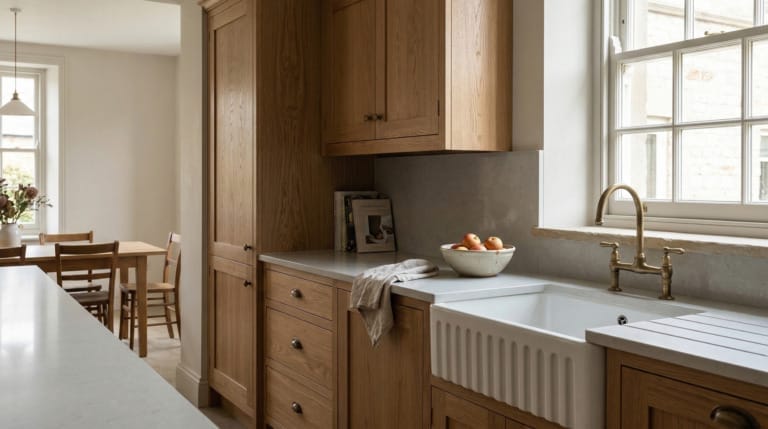
This doesn’t mean everything has to match exactly. Mixing brushed brass handles with a chrome tap, for instance, can work well if the tones are close and the overall palette is warm. But a polished chrome handle next to a matte black tap and a brushed nickel light fitting is usually too much variation in a single space.
The practical approach is to decide on your primary metal finish early, before you’ve committed to taps or lighting, and use that as a reference point for everything else. It’s much easier to adjust a tap choice than to reorder forty handles.
Thinking about handleless kitchens
Handleless cabinetry is a legitimate design choice, not a shortcut. Push-to-open mechanisms and J-pull or G-profile rails can give a very clean result, particularly in contemporary kitchens where the cabinetry itself is the feature.
But handleless isn’t maintenance-free. Push-to-open mechanisms need to be well-specified and properly adjusted, because a soft-close that fails on a frequently used door becomes irritating quickly. J-pull rails, which run along the top or bottom edge of the door, can collect grease and dust in a kitchen environment and need to be considered in terms of cleaning access.
If you’re drawn to a handleless look, think about where you actually open things most often. Some people find a fully handleless kitchen feels slightly clinical over time. A hybrid approach, handleless upper cabinets with a discreet rail or handle on lower drawers, can give you the visual calm you’re after without the practical compromises

Getting the fixing position right
Even a well-chosen handle can look wrong if it’s positioned poorly on the door. The standard fixing position for a bar handle on a door is towards the opening edge, set in from the corner at a consistent distance. That distance should be the same on every door in the kitchen.
On drawers, handles are typically centred horizontally. On tall doors, the handle is usually positioned at a comfortable hand height rather than at the geometric centre of the door, because the geometric centre of a tall larder unit is often too low to feel natural.
These are decisions your designer and installer should be making carefully, but it’s worth asking about them. A millimetre or two of inconsistency across a run of cabinetry is visible, and it’s the kind of thing that bothers you more, not less, as time goes on.
How Mastercraft approaches this
At Mastercraft, handle selection is part of the design conversation from early on, not an afterthought. We look at the door profile, the cabinetry layout, the room’s natural light, and the other metal finishes in the space before we make any recommendation. The goal is always coherence, a kitchen where every detail feels like it belongs.
We work with a carefully considered range of handles across different styles and finishes, and we’re direct about what will and won’t work in a given design. If a handle you’ve seen elsewhere isn’t right for your cabinetry, we’ll tell you why and show you something that is.
Every Mastercraft kitchen is designed as a whole. That means the handle choice is made in context, not in isolation, and it’s checked against the full specification before anything goes into production.
Explore more from Mastercraft Kitchens
If you’re planning a new kitchen, you can find out more about our work across the north of England and beyond:
- fitted kitchens in Liverpool
- fitted kitchens in Epsom
- fitted kitchens in Harrogate
- fitted kitchens in Leeds
- fitted kitchens in Stratford upon Avon
- bespoke kitchens in Yorkshire
If you’d like to talk through your kitchen design with one of our designers, we’d be glad to arrange a consultation. It’s a straightforward conversation, and it costs nothing to have it.
Frequently asked questions
What size handles should I choose for kitchen drawers?
As a general guide, the handle should feel proportionate to the drawer width rather than sitting as a small detail in the centre. For a standard 600mm pan drawer, a handle of 160mm to 192mm can look right. For narrower drawers, 96mm to 128mm is usually more appropriate. The key is that handles on a stack of drawers should form a consistent, even vertical line.
Should my kitchen handles match my taps?
They don’t need to match exactly, but they should sit comfortably in the same tonal family. Brushed brass handles and a brushed brass tap is an obvious pairing, but brushed brass handles with a warm brushed nickel tap can also work well. What can look unsettled is mixing very different finishes, such as polished chrome and matte black, in the same visual field.
Are handleless kitchens practical for everyday use?
Yes, when they’re well-specified. Push-to-open mechanisms need to be good quality and properly set up, because a mechanism that loses its tension on a frequently used door becomes a daily frustration. J-pull and G-profile rails are generally more reliable for heavy use, but they do require regular cleaning as they can collect grease along the channel.
Can I mix handle styles in the same kitchen?
You can, but it needs to be deliberate rather than accidental. A common approach is to use a bar handle on drawers and a cup handle on doors, keeping the same finish throughout. What can look unintentional is mixing finishes, such as brushed brass on some cabinets and chrome on others, without a clear design reason for doing so.
Where should handles be positioned on tall larder doors?
On a tall larder or full-height door, the handle is usually positioned at a comfortable hand height rather than at the geometric centre of the door. The geometric centre of a 2100mm door would sit at around 1050mm from the floor, which is often lower than feels natural to reach. A position of around 1200mm to 1400mm from the floor can be more comfortable in practice.