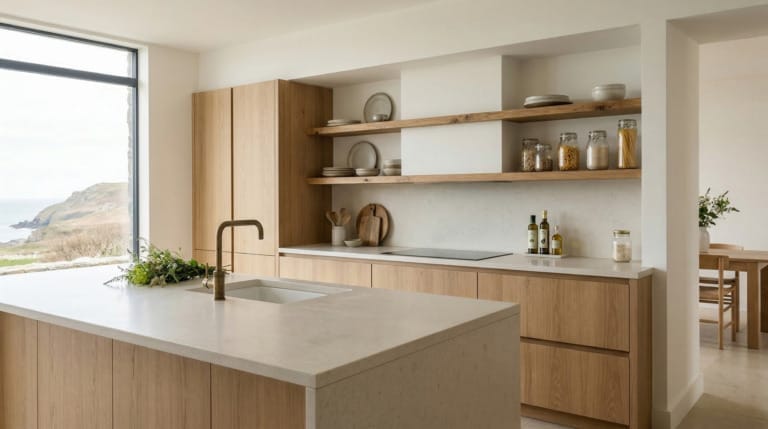
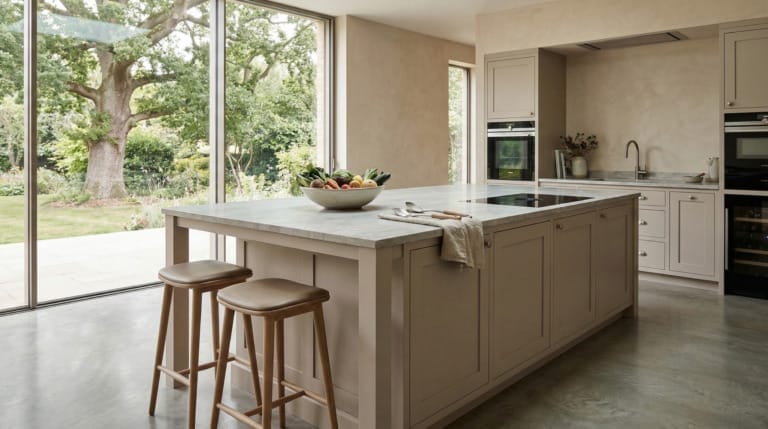
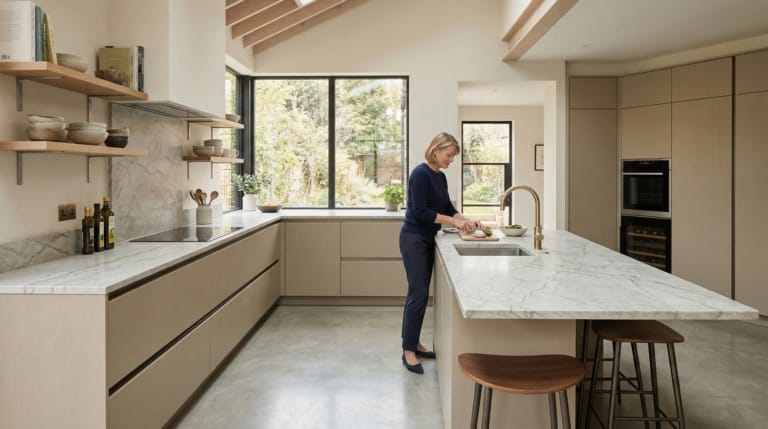
If cooking is something you do properly and often, your kitchen needs to be planned around that from the start. The decisions that matter most are rarely the ones that photograph well. They’re the ones that affect how the space works when you’re mid-service with three things on the go
Start with the cooking zone, not the layout
Most kitchen layouts are planned around the room’s architecture first and the cooking second. That’s often the wrong order. If you cook seriously, the position and specification of your cooking zone should drive the rest of the design, not the other way around.
That means thinking early about what you’re cooking on, how much ventilation it needs, and what you need within arm’s reach. A range cooker with a high-output gas hob behaves very differently from an induction hob set into a run of worktop. The space around it, the extraction above it, and the storage adjacent to it all need to be designed to match.
It also means being honest about how you work. Some people cook in a tight, focused area and want everything close. Others move around more and need clear routes between the hob, the prep area, and the sink. Neither is wrong, but they produce different layouts.
Extraction that actually keeps up
Extraction is one of the most underspecified parts of a kitchen, particularly when someone is cooking at high heat or using a range cooker regularly. A decorative hood that looks the part but moves too little air will leave your kitchen smelling of last night’s dinner.
The output you need depends on the size of the room and what you’re cooking on. As a rough guide, a high-output gas hob or a range cooker with multiple burners will need significantly more extraction capacity than a standard four-zone induction hob. Your designer should be specifying extraction to match the appliance, not just the aesthetic.
Ceiling-mounted extractors and integrated downdraft systems have improved considerably, and they suit certain layouts well. But a well-positioned chimney hood with the right motor remains the most reliable option for most serious cooking kitchens. The key is getting the airflow calculation right, not just choosing the one that looks best.
Worktop space and where it sits
Serious cooking requires proper prep space, and that means thinking carefully about where your worktop sits in relation to the hob and the sink. A large island looks impressive, but if it’s positioned so that you’re carrying heavy pans across the room to reach it, it’s not working for you.
The most useful prep space is directly adjacent to the cooking zone, ideally on both sides if the layout allows. One side for raw preparation, one side for plating or resting. That’s a simple principle, but it’s often lost when a kitchen is designed primarily around how it looks from the doorway.
Worktop material matters here too. Stone and quartz are hardwearing and heat-tolerant, but they’re cold to work on and unforgiving if you drop things. A section of solid timber can be useful for pastry work or as a dedicated chopping area. Some kitchens benefit from a mix of surfaces, each positioned where it’s most useful

Storage designed around how you actually cook
Generic kitchen storage is designed around a generic idea of cooking. If you cook seriously, your storage needs to reflect what you actually own and how you use it.
Deep pan drawers are almost always more useful than base cupboards for heavy cookware. You can see everything, access it without crouching, and pull the drawer fully out to reach items at the back. The same principle applies to larder units: a well-designed pull-out larder with adjustable shelving gives you far better visibility and access than a standard tall cupboard.
Spice storage is worth thinking about specifically. If you cook with a wide range of spices, a dedicated pull-out column or a deep drawer with a tiered insert positioned close to the hob makes a real difference to how quickly you can work. Small things like this, planned in at the design stage, are what separate a kitchen that functions well from one that just looks the part.
Think also about where you store your most-used items versus your occasional ones. Heavy cast iron pans should be stored at a height that doesn’t require lifting them above shoulder level. Serving dishes used once a month can go higher. That sounds obvious, but it’s rarely thought through properly.
Sinks and water where you need it
A single large sink positioned well is more useful than two sinks positioned awkwardly. For serious cooking, a deep single bowl gives you room to fill large pots, wash bulky items, and keep things moving. A second, smaller prep sink on the island or in a secondary run is worth considering if your layout allows it and you regularly have more than one person working in the kitchen.
Boiling water taps have become a practical choice rather than a luxury for many people who cook regularly. Filling a large pan for pasta or blanching vegetables is faster, and the tap replaces the kettle on the worktop. Whether that trade-off is worth it depends on how you cook and how much worktop space matters to you.
The position of the sink relative to the hob and the dishwasher is worth mapping out carefully. You want a clear, short route between all three. If you’re carrying a heavy pot of water from the sink to the hob across the room, the layout isn’t working as well as it could.
Lighting that supports the work
Task lighting in a cooking kitchen is not optional. Ambient ceiling lighting alone leaves you working in your own shadow, which is frustrating and, when you’re using sharp knives, genuinely problematic.
Under-cabinet lighting positioned directly above the worktop is the most effective solution for prep areas. LED strips are now slim enough to sit discreetly under the cabinet and throw good, even light onto the surface below. The colour temperature matters: a warm white around 2700K suits a kitchen that’s used in the evenings, but a slightly cooler tone around 3000K gives better clarity for detailed prep work.
Above the island, pendant lighting needs to be positioned at the right height. Too high and it doesn’t light the surface properly. Too low and it gets in the way. As a general rule, the bottom of the pendant should sit around 75 to 80 centimetres above the worktop surface, though this varies depending on the pendant style and the height of the people using the kitchen

How Mastercraft approaches this
When we design a kitchen for someone who cooks seriously, we start by understanding how they actually work in the space. That means asking about what they cook, how often, whether they cook alone or with others, and what frustrates them about their current kitchen. The answers shape every decision that follows.
We don’t apply a standard layout and adjust it to fit. We work out where the cooking zone should sit, what extraction it needs, how the storage should be organised, and where the prep space needs to be, and then we build the design around those answers. The cabinetry, the materials, and the finishes come after the function is resolved.
Every kitchen we make is designed and built specifically for the person using it. That’s not a marketing position. It’s the only way to produce a kitchen that works properly over the long term, particularly for someone who spends real time cooking in it.
Explore more from Mastercraft Kitchens
If you’re planning a new kitchen and want to see what’s possible, you can find our work across the North of England and beyond.
- fitted kitchens in Liverpool
- fitted kitchens in Wellingborough
- fitted kitchens in Harrogate
- fitted kitchens in Leeds
- fitted kitchens in Wirral
- bespoke kitchens in Yorkshire
If you’d like to talk through your kitchen project with one of our designers, we’d be glad to arrange a consultation. Get in touch and we can start with a conversation about how you use your kitchen and what you want it to do.
Frequently asked questions
How much extraction do I need for a range cooker?
As a general guide, you need an extractor that can move at least ten times the volume of your kitchen’s air per hour, and more if you’re cooking at high heat regularly. For a typical range cooker with multiple burners, look for a motor rated at 700 to 1000 cubic metres per hour or above. Your designer should specify extraction to match the appliance output, not just the available space.
What’s the best worktop material for a kitchen used for serious cooking?
Quartz and natural stone are the most practical choices for a hardworking kitchen. They’re heat-tolerant, easy to clean, and durable over time. Some people add a section of solid timber for pastry work or as a dedicated chopping area, which works well as long as it’s properly maintained. The key is matching the material to how each part of the worktop will actually be used.
Are pan drawers better than base cupboards for storing cookware?
For most people who cook regularly, yes. Deep pan drawers let you see everything at a glance, pull the drawer fully out to reach items at the back, and avoid the crouching and rummaging that comes with a standard base cupboard. They’re particularly useful for heavy cast iron or stainless steel cookware that you use often.
Where should a prep sink be positioned in a cooking kitchen?
Ideally close to the main cooking zone, so you’re not carrying heavy pots or wet ingredients across the room. If you have an island, a secondary prep sink set into it can work well, particularly if two people cook together. The most important thing is that the sink, hob, and dishwasher form a logical triangle with short, clear routes between them.
What colour temperature should kitchen task lighting be?
For under-cabinet task lighting above prep areas, a colour temperature of around 2700K gives a warm, comfortable light for evening cooking. If you want slightly better clarity for detailed prep work, 3000K is a practical choice without feeling clinical. Avoid anything above 4000K in a domestic kitchen, as it can feel harsh and unflattering.