Appliances that combine a microwave, oven, and air fryer into a single cavity are becoming more capable, and more common. If you’re planning a kitchen from scratch, it’s worth understanding what that means for your layout before you make any decisions.
What combination appliances actually do
A combination appliance typically pairs a conventional oven with microwave function, and increasingly with a hot air or air fry setting as well. The idea is that one cavity handles most of what you’d normally spread across two or three appliances.
In practice, the cooking results vary by brand and model. Some combination ovens perform very well across all modes. Others are a reasonable compromise. The key question for kitchen planning isn’t whether the appliance is good – it’s whether your layout can accommodate it properly and whether it genuinely fits how you cook.
If you use a microwave several times a day but rarely use a conventional oven, a combination unit might suit you well. If you cook for a family and rely on a full-size oven regularly, you’ll likely want that as a separate appliance alongside a combination unit, not instead of one
How a combination appliance affects your cabinetry
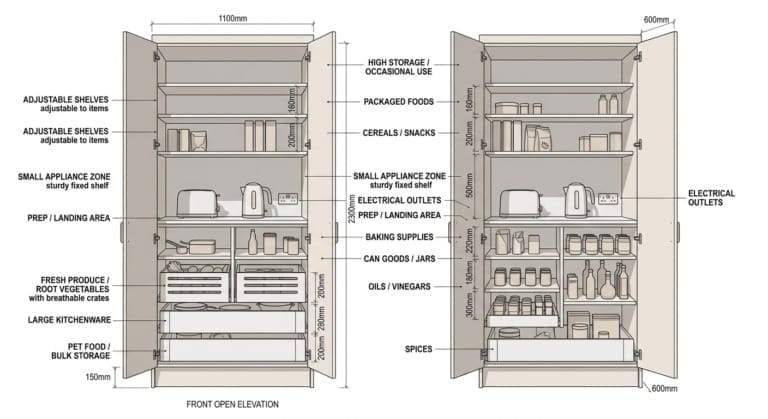
This is where the planning conversation gets specific. A standard built-in microwave sits in a relatively compact housing, usually at eye level or just below. A combination oven is a heavier, deeper appliance with different ventilation requirements and often a larger cavity.
If you’re replacing a standalone microwave with a combination unit, the housing may need to change. The depth, the ventilation clearances, and the structural support within the cabinet all need to be right. Getting this wrong causes problems – poor ventilation shortens appliance life and can create heat damage to surrounding cabinetry.
For a new kitchen, this is straightforward to design around. For a retrofit, it depends entirely on what’s already there. It’s one of the reasons appliance decisions should be made early in the design process, not after cabinetry has been specified.
Worktop appliances versus built-in: the real trade-off
Some people prefer a freestanding combination appliance that sits on the worktop. It’s a lower upfront cost and you can take it with you if you move. But it occupies worktop space permanently, and in a well-designed kitchen, worktop space is usually one of the things you’ve worked hardest to protect.
A built-in combination oven, set into a housing column or a run of tall units, keeps your surfaces clear and integrates the appliance properly into the room. It also can look more considered, which matters if you’re investing in a bespoke kitchen.
The honest trade-off is cost and flexibility. Built-in appliances cost more to install and replace. Worktop appliances are easier to swap out but harder to live with day to day in a kitchen where space and workflow have been carefully planned

Colour and finish: when appliance aesthetics matter
Some combination appliances are available in a range of colours, including softer, more decorative finishes. This can work well in certain kitchens, particularly where the appliance is visible and you want it to contribute to the overall palette rather than disappear.
That said, colour choices in appliances carry a risk that cabinetry colours don’t. Cabinetry can be repainted. An appliance in a specific shade is harder to update, and if your kitchen evolves over time, a strongly coloured appliance can start to feel fixed in a way that limits your options.
If you’re drawn to a particular finish, think about how it sits against your cabinetry, worktops, and hardware. A warm cream appliance in a kitchen with cool grey units and chrome handles will fight rather than complement. Colour in appliances works best when it’s been considered as part of the whole, not chosen in isolation.
Thinking about workflow, not just specification
The most useful question to ask about any appliance is how you’ll actually use it. A combination unit that handles reheating, roasting, and crisping sounds efficient, but if you’re regularly cooking for four or more people, you may find yourself waiting for one function to finish before you can use another.
Workflow in a kitchen is about more than appliance capability. It’s about where things are positioned relative to each other, how you move between preparation, cooking, and serving, and whether the appliances you use most are at the right height and in the right location.
A combination oven positioned at eye level in a tall housing is easy to use for everyday reheating. The same appliance set low in a base unit is awkward for anything that requires you to check on food or lift a hot dish. Height and position matter as much as the appliance itself

How Mastercraft approaches this
When we’re designing a kitchen, appliance decisions are part of the brief from the start. We ask about how you cook, how often, and for how many people. That shapes not just which appliances we specify, but where they go, how they’re housed, and how the layout supports the way you actually use the room.
Combination appliances can be a genuinely good fit for certain kitchens, particularly where the brief calls for a compact layout or where a client wants to reduce the number of separate machines. We’ll specify them where they make sense and design the cabinetry around them properly, with the right housing, ventilation, and access.
What we don’t do is treat appliance choices as an afterthought. In a bespoke kitchen, every element is considered in relation to everything else. The appliances you choose affect the cabinetry, the workflow, and the long-term practicality of the room. Getting that right at the design stage is far easier than trying to adapt later.
Explore more from Mastercraft Kitchens
If you’re planning a new kitchen and want to see what’s possible in your area, you can find our work and services here:
- fitted kitchens in Liverpool
- fitted kitchens in Manchester
- fitted kitchens in Harrogate
- fitted kitchens in Leeds
- fitted kitchens in Wirral
- bespoke kitchens in Yorkshire
If you’d like to talk through your appliance choices as part of a wider kitchen design, we’re happy to arrange a consultation. It’s a good starting point for understanding what will work best in your space.
Frequently asked questions
Can a combination microwave oven replace a full-size conventional oven?
For some people, yes. If you mostly cook for one or two and don’t regularly roast large joints or bake on multiple trays, a combination oven can handle most of what you need. For families or anyone who cooks in volume, a full-size oven alongside a combination unit is usually the more practical arrangement.
What cabinetry changes are needed to house a combination oven?
It depends on the appliance. Combination ovens are typically heavier and deeper than standard microwaves, and they need adequate ventilation clearances around the cavity. If you’re fitting one into an existing housing, check the manufacturer’s specifications carefully. In a new kitchen, the housing can be designed around the appliance from the start, which is the cleaner approach.
Is it better to have a built-in combination oven or a worktop model?
Built-in is generally the better choice in a well-designed kitchen. It keeps your worktops clear, integrates the appliance properly into the cabinetry, and positions it at a practical height. Worktop models are more flexible and lower cost, but they take up permanent surface space, which is usually worth protecting.
How do I choose the right height for a built-in combination oven?
Eye level or just below is the most practical position for a combination oven used regularly for reheating and cooking. It means you can see into the cavity easily and lift dishes out safely. Avoid positioning it too low in a base unit if you’ll be using it frequently, as bending to check on food or remove hot dishes becomes tiring quickly.
Do coloured appliances work in a bespoke kitchen?
They can, but the colour needs to be chosen as part of the overall design rather than separately. Think about how the appliance finish sits alongside your cabinetry colour, worktop material, and hardware. A strongly coloured appliance is harder to update than painted cabinetry, so it’s worth being confident in the choice before committing.