Open shelving comes up in almost every kitchen design conversation, and it’s easy to see why. Done well, it lightens a space, gives you quick access to everyday items, and lets the things you own become part of the room. Done poorly, it creates clutter, collects grease, and becomes something you stop seeing properly after about a fortnight.
The question isn’t whether open shelving looks good. It’s whether it’s the right choice for your kitchen, your layout, and the way you actually cook.
What open shelving does well
The strongest argument for open shelving is visual breathing room. A run of wall cabinets can feel heavy, particularly in a kitchen that doesn’t have much natural light. Replacing one or two of those cabinets with open shelves breaks up the mass and makes the room feel less enclosed.
It also works well for things you reach for constantly. Oils, everyday plates, glasses, a few jars of dry goods. If something lives on a shelf rather than behind a door, you save yourself the small but cumulative friction of opening and closing cabinets dozens of times a day.
There’s also a practical case for shelving near a hob or prep area. A short run of shelves at the right height, holding the things you use while cooking, can make a kitchen genuinely easier to work in. It’s not about display. It’s about reducing the distance between your hands and what you need
Where it can go wrong
The most common mistake is treating open shelving as a styling decision rather than a storage decision. If you’re choosing it because it looks good in photographs, that’s worth pausing on. The reality of open shelving is that everything on it is always visible, always accumulating dust, and always subject to the ambient grease that comes with regular cooking.
Shelving near a hob is particularly vulnerable. Even with good extraction, surfaces close to cooking pick up residue over time. Anything stored there needs to be in regular enough use that it gets cleaned naturally, or you’ll find yourself wiping down jars and bottles every few weeks.
It also demands a level of organisation that not every kitchen suits. If your storage is already stretched, open shelving won’t solve that. It will just make the overflow more visible. Shelving works best when it holds a curated, stable selection of items, not when it becomes the overflow from cabinets that are already full.
How to think about placement
Placement matters more than quantity. A single well-positioned shelf can do more for a kitchen than a whole wall of them. Think about where you naturally reach during cooking and where a shelf would genuinely reduce effort rather than just add visual interest.
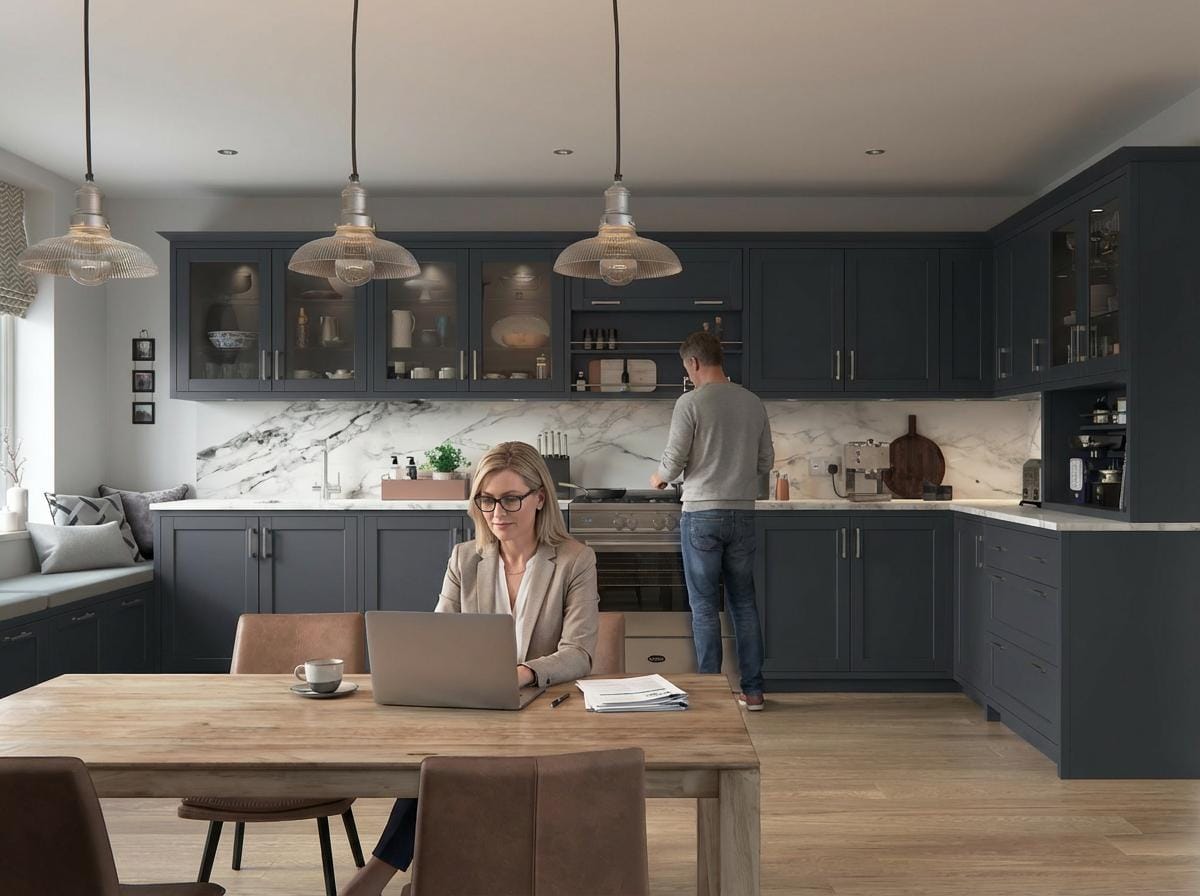
Corner runs of wall cabinets are often a good candidate for shelving. The corner itself is awkward storage anyway, and opening it up can make the whole run feel less oppressive. A shelf that wraps a corner, or simply stops short of it, can change the proportion of the room without sacrificing much practical storage.
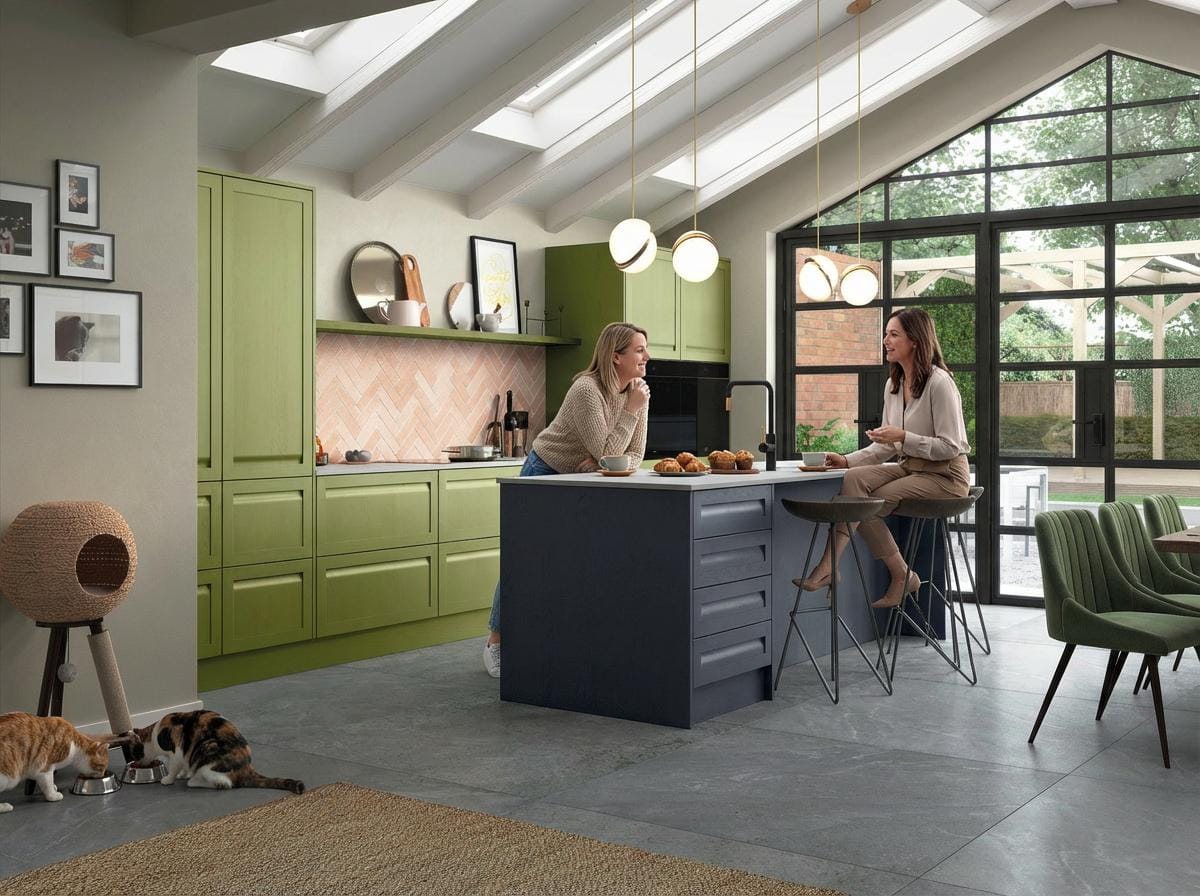
Above a window is another position worth considering. A shelf at high level, above the frame, gives you somewhere to store things you don’t need often while keeping the window clear. It reads as architectural rather than functional, which suits certain kitchens well.
What can work less well is a long continuous run of open shelving replacing an entire wall of cabinets. The storage loss is significant, and the visual effect can feel busy rather than calm unless everything on the shelves is very deliberately chosen and maintained

Materials and proportion
The shelf itself needs to be right for the room. Timber shelving in a painted kitchen adds warmth and texture, particularly if the rest of the cabinetry is relatively flat. A thick solid oak shelf reads very differently from a thin MDF board with a veneer, and in a bespoke kitchen the difference is immediately obvious.
Thickness matters more than most people expect. A shelf that’s too thin looks insubstantial and can bow under the weight of ceramics or glassware. For most kitchens, a shelf depth of around 25 to 30 centimetres and a thickness of at least 40 millimetres in solid timber will hold its shape and look properly considered.
Brackets are part of the design, not an afterthought. Concealed fixings give a clean, floating appearance that works well in handleless or contemporary kitchens. Visible brackets, in steel or brass, can be a deliberate design choice in a more traditional or industrial-influenced space. Either can work, but the choice should be made intentionally.
The relationship between the shelf and the cabinetry around it also needs thought. A shelf that sits at the same height as the top of the wall cabinets, or that aligns with a horizontal line already present in the room, will feel resolved. One that floats at an arbitrary height can look like an afterthought.
What to put on open shelves
This is where many kitchens run into difficulty. The items that look good on open shelving are not always the items that need to be most accessible, and the items that need to be most accessible are not always the ones you’d choose to display.
The most practical approach is to think in categories. Everyday crockery, if it’s consistent and reasonably attractive, works well on shelves because it’s used and washed regularly enough to stay clean. Glassware is similar. A set of matching glasses on a shelf is both practical and visually coherent.
Jars and containers work if they’re uniform. A collection of mismatched packaging, even if the contents are the same, can look cluttered. Decanting dry goods into matching jars is a commitment, but it does make a real difference to how a shelf reads.
Things that don’t work well on open shelves include anything you use infrequently, anything that comes in packaging you’d rather not look at, and anything that accumulates grease quickly. Pots and pans can look good in the right context, but they need to be in constant rotation to stay clean enough to display

Combining shelving with closed storage
The kitchens where open shelving can work best are the ones where it’s used selectively alongside well-planned closed storage. The shelves hold the things that benefit from being open. The cabinets hold everything else.
This means the closed storage needs to be properly thought through before you decide what goes on the shelves. If your cabinet layout is efficient and your everyday items have a logical home, you can afford to be selective about what sits on display. If the cabinets are doing too much work, the shelves will end up absorbing the overflow.
In practical terms, this often means being more generous with drawer storage than you might initially plan. Deep drawers for pots and pans, shallower drawers for utensils and everyday items, and well-organised larder or pantry space for dry goods all reduce the pressure on open shelving to do functional work it’s not well suited to.
How Mastercraft approaches this
When open shelving comes up in a design conversation, we start by asking what it needs to do. If the answer is primarily about aesthetics, that’s worth exploring further before committing. If the answer is about workflow, access, or breaking up a heavy run of cabinetry, there’s usually a strong case for it.
We design shelving as part of the overall storage plan, not as a separate decision. That means working out what goes where across the whole kitchen before settling on which elements should be open and which should be closed. The shelving position, material, and proportion are resolved in relation to the cabinetry around it, not in isolation.
Every Mastercraft kitchen is designed around how you use the space. That means the shelving, if it’s there, is there for a reason. It’s sized properly, positioned where it earns its place, and made from materials that suit the rest of the room. It’s not added because it photographs well. It’s added because it makes the kitchen work better for you.
Start your Mastercraft design consultation
You'll work directly with a Mastercraft designer to plan a kitchen around your home, your layout and how you live day to day. From the first sketches through to technical planning and installation, everything is handled by one experienced in-house team.
Designed around your home
Every kitchen is made-to-measure for your room, your architecture and the way you use the space.
Technical survey included
We measure and plan everything before production begins so your kitchen fits exactly as intended.
Materials and samples
See door finishes, worktops and colours in your own home before making final decisions.

Browse the Mastercraft design library
Inside you'll find our brochures, design guides, material references and any current Mastercraft offers. A practical starting point if you're thinking about a kitchen but not ready to talk yet.
Explore more from Mastercraft Kitchens
If you’re planning a kitchen project, you can find more about our work across the UK here:
- fitted kitchens in Liverpool
- fitted kitchens in Lytham St Annes
- fitted kitchens in Harrogate
- fitted kitchens in Leeds
- fitted kitchens in Wirral
- bespoke kitchens in Yorkshire
If you’d like to talk through your kitchen design with us, we’re happy to arrange a consultation. We’ll look at your space properly and give you considered advice before any decisions are made.
Frequently asked questions
Is open shelving practical in a kitchen you cook in every day?
It can be, but it depends on what you put on the shelves and where they’re positioned. Items that are used and washed regularly, such as everyday plates and glasses, stay clean naturally. Shelving near a hob or in a kitchen without good extraction will need more frequent cleaning, so it’s worth factoring that in before you commit.
How deep should kitchen shelves be?
For most kitchens, a shelf depth of around 25 to 30 centimetres works well. It’s deep enough to hold standard crockery and glassware without items overhanging the front, but not so deep that things get lost at the back. Shallower shelves, around 15 to 20 centimetres, can work well for spices or small jars in a more compact space.
What thickness should a kitchen shelf be?
In solid timber, a thickness of at least 40 millimetres will hold its shape under the weight of ceramics or glassware and look properly substantial. Thinner shelves can bow over time, particularly over longer spans. If you’re using a shelf over 80 centimetres wide, it’s worth considering a central bracket or a thicker board to prevent any movement.
Can open shelving replace wall cabinets entirely?
Replacing all your wall cabinets with open shelving is a significant storage trade-off, and it only works if your base and tower storage is very well planned. For most kitchens, a mix of open shelving and closed cabinets gives you the visual lightness of shelving without losing the practical storage that wall cabinets provide.
How do I stop open kitchen shelves from looking cluttered?
The most effective approach is to limit what goes on the shelves to items that are used regularly, consistent in appearance, and easy to keep clean. Matching containers, uniform crockery, and a small number of well-chosen objects tend to read more calmly than a mix of different shapes, colours, and packaging. Editing is easier if your closed storage is doing its job properly.