Natural stone is one of the most debated choices in kitchen design, and for good reason. It’s beautiful, it’s individual, and it’s a long-term commitment that deserves more thought than a showroom visit and a quick sample comparison.
If you’re seriously considering stone for your kitchen, here’s what’s worth understanding before you make any decisions.
Why stone behaves differently to other worktop materials
Natural stone is a geological material, not a manufactured one. That means every slab has its own character, its own internal structure, and its own set of properties that affect how it performs in a working kitchen. Two slabs from the same quarry can behave quite differently depending on their mineral composition and density.
Marble, granite, quartzite, and limestone are all natural stone, but they are not interchangeable. Marble is calcium carbonate, which means it reacts to acids. Granite is much harder and more resistant. Quartzite is often confused with quartz, but it’s a natural metamorphic rock with different properties entirely. Knowing which material you’re actually looking at matters.
The surface finish also changes how the stone behaves. A polished finish is denser and less porous at the surface, which makes it slightly easier to maintain. A honed or leathered finish looks more natural and is less likely to show fine scratches, but it can be more absorbent and needs sealing more carefully
Understanding porosity and why it matters in a kitchen
Portosity is the single most practical consideration when choosing natural stone for a kitchen worktop. A porous stone will absorb liquids if it’s not properly sealed, and in a kitchen that means oils, wine, coffee, and acidic foods can leave permanent marks.
Granite is generally low in porosity, which is one reason it has been used in kitchens for decades. Many marbles are more porous and more reactive, which doesn’t make them a bad choice, but it does mean you need to go in with realistic expectations about care. A marble worktop in a busy family kitchen will develop a patina over time. Some people find that beautiful. Others find it frustrating.
Before any stone is installed, it should be sealed with a quality impregnating sealer. This doesn’t make the surface impervious, but it gives you time to wipe up spills before they penetrate. Resealing every year or two is part of owning a natural stone worktop, and it’s worth factoring that into your decision.
How slab selection affects the finished result
One of the most important steps in a natural stone project is slab selection, and it’s a step that many people skip or leave entirely to their supplier. If you’re investing in a natural stone worktop, you should view the actual slab you’re buying, not just a sample tile.
A sample gives you a rough sense of colour and veining, but it tells you very little about how the full slab will look across a large run of cabinetry. The veining on a marble slab can shift dramatically from one end to the other. The background colour can vary. What looks like a calm, consistent stone on a small tile can be quite dramatic at full scale.
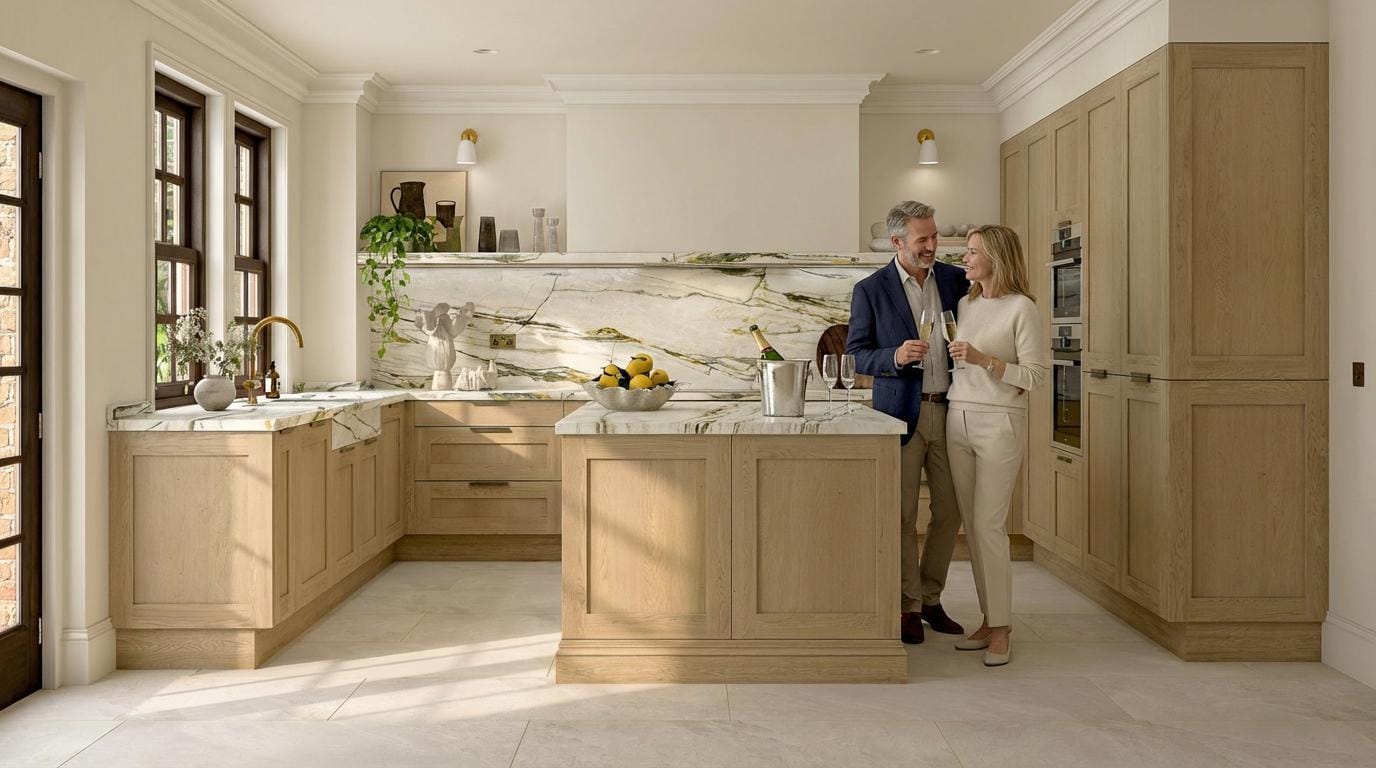
If your kitchen has a large island or a long run of worktop, you may need more than one slab. In that case, how the slabs are matched and joined becomes a design decision in itself. A skilled fabricator can bookmatch slabs, mirroring the veining across a join, which can look exceptional on an island. It requires careful planning and usually costs more, but the result is worth it

Thickness, edge profiles, and proportion
Worktop thickness is something that gets decided quite late in many projects, but it has a significant effect on how the kitchen looks and feels. Standard worktop thickness for natural stone is typically 20mm or 30mm. A 20mm slab looks lighter and more refined. A 30mm slab has more visual weight and works well on a large island or in a kitchen with substantial cabinetry.
Some designers use a mitred edge to create the appearance of a much thicker slab without the additional weight or cost. This involves bonding a strip of stone underneath the front edge so it reads as 60mm or more from the front. Done well, it looks convincing and adds real presence to an island.
Edge profiles are worth thinking about carefully. A simple eased or pencil-round edge can age well and suits most kitchen styles. More ornate profiles can look dated and are harder to keep clean. If you’re unsure, simpler is usually the better long-term choice.
What to ask your fabricator before work begins
The quality of the fabrication is just as important as the quality of the stone. A beautiful slab cut and installed poorly will cause problems, and some of those problems are very difficult to fix once the worktop is in place.
Ask your fabricator how they handle the templating process. A good fabricator will template from the actual installed cabinetry, not from drawings, because small discrepancies in a room can affect the fit of a worktop significantly. Ask how they plan to support the stone at any overhangs, particularly on an island where you might have seating. Stone is heavy and brittle, and unsupported overhangs can crack.
Ask about the join positions too. Joins are unavoidable on longer runs, but where they fall matters. A join running through the middle of a hob cutout is a weak point. A join positioned away from cutouts and at a natural break in the layout is much better. A fabricator who has thought about this before you ask is a good sign

Living with natural stone day to day
Natural stone is not a low-maintenance material, and it’s worth being honest with yourself about how you use your kitchen before committing to it. If you cook frequently, leave things on the worktop, and don’t want to think carefully about what touches the surface, an engineered quartz might serve you better.
That said, the care requirements for stone are not onerous if you understand them. Wipe up spills promptly, use a chopping board, avoid placing very hot pans directly on the surface, and reseal the stone periodically. These are simple habits, and for most people they become second nature quickly.
The reward is a worktop that is genuinely unique. No two natural stone surfaces are the same, and a well-chosen slab in a well-designed kitchen has a quality that engineered materials can’t fully replicate. The variation, the depth, and the way stone responds to light across the day are things that tend to matter more to people the longer they live with them.
How Mastercraft approaches this
At Mastercraft, we treat worktop selection as a design decision that runs through the whole kitchen, not a separate choice made at the end. The material, finish, thickness, and edge profile all affect how the cabinetry reads, how the space feels, and how the kitchen holds up over years of daily use.
We work with our customers through the slab selection process rather than leaving it to chance. That means visiting suppliers together where possible, thinking carefully about how the veining and colour will sit against the cabinetry finish, and making sure the fabrication brief is precise before anything is cut.
Every Mastercraft kitchen is designed around the way you actually use your home. If natural stone is the right choice for your project, we’ll help you choose it well. If a different material would serve you better, we’ll tell you that too.
Start your Mastercraft design consultation
You'll work directly with a Mastercraft designer to plan a kitchen around your home, your layout and how you live day to day. From the first sketches through to technical planning and installation, everything is handled by one experienced in-house team.
Designed around your home
Every kitchen is made-to-measure for your room, your architecture and the way you use the space.
Technical survey included
We measure and plan everything before production begins so your kitchen fits exactly as intended.
Materials and samples
See door finishes, worktops and colours in your own home before making final decisions.

Browse the Mastercraft design library
Inside you'll find our brochures, design guides, material references and any current Mastercraft offers. A practical starting point if you're thinking about a kitchen but not ready to talk yet.
Explore more from Mastercraft Kitchens
If you’re planning a kitchen project and would like to see more of our work, you can find us here:
- fitted kitchens in Liverpool
- fitted kitchens in Ormskirk
- fitted kitchens in Harrogate
- fitted kitchens in Leeds
- fitted kitchens in Wirral
- bespoke kitchens in Yorkshire
If you’re at the planning stage and would like to talk through your options with one of our designers, we’d be glad to arrange a consultation. Get in touch and we can start from wherever you are in the process.
Frequently asked questions
Is marble a practical choice for a kitchen worktop?
Marble can work well in a kitchen if you go in with realistic expectations. It is softer and more porous than granite, so it will mark and etch over time, particularly from acidic foods and liquids. Some people find the patina that develops adds to the character of the stone. If you want a surface that stays pristine with minimal effort, marble is probably not the right choice.
How often does a natural stone worktop need to be sealed?
Most natural stone worktops benefit from resealing once a year, though some denser stones like granite may need it less frequently. A simple water test will tell you when it’s time: if water no longer beads on the surface and instead soaks in, the seal has worn. Resealing is straightforward and can be done yourself with the right impregnating sealer.
What is the difference between quartzite and quartz?
Quartzite is a natural metamorphic rock formed from sandstone under heat and pressure. Quartz worktops are an engineered product made from crushed quartz bound with resin. Quartzite is a natural stone with all the variation and care requirements that implies. Engineered quartz is more consistent and generally lower maintenance. The two are often confused in showrooms, so it’s worth asking directly which you’re looking at.
Can natural stone worktops be repaired if they chip or crack?
Minor chips can often be filled and polished by a specialist fabricator, and the repair is usually hard to spot on a heavily veined stone. Cracks are more serious and depend on where they are and how they occurred. A crack near a cutout, such as around a sink or hob, may indicate a structural issue that needs proper assessment. Prevention through correct installation and support is far better than repair.
Does the finish I choose affect how the stone performs?
Yes, the finish makes a real difference. A polished finish creates a denser surface that is slightly more resistant to staining, though it will show fingerprints and fine scratches more readily. A honed finish is more forgiving in terms of surface marks but can be more absorbent and needs careful sealing. A leathered or brushed finish sits somewhere between the two and suits certain stone types particularly well.