If you cook regularly and take it seriously, your kitchen needs to do more than look good. It needs to handle heat, noise, mess, and the particular rhythm of how you work. Getting that right is mostly a matter of thinking clearly about the design before anything gets built.
Extraction is more important than most people budget for
A powerful extractor is one of those things that feels like a luxury until you’ve cooked without one. If you’re using a range cooker or a high-output hob, you need extraction that can genuinely keep up. That means thinking about airflow capacity, duct routing, and how far the hood sits above the cooking surface.
Ceiling-mounted island extractors look clean, but they need a clear duct run to the outside. Recirculating models are a compromise, and they show their limits quickly when you’re cooking at high heat. If you’re planning a serious kitchen, it’s worth routing a proper external duct from the start, even if it takes more work during the build.
The size of the hood matters too. It should overhang the hob on all sides, not sit flush with it. A hood that’s too small for the cooking surface will always underperform, regardless of its rated output
Worktop space and where you put it
Serious cooking uses a lot of surface area. You need somewhere to prep, somewhere to rest hot pans, somewhere to plate up, and ideally a clear run between the hob and the sink. If your worktop layout doesn’t support that sequence, you’ll be working around the kitchen rather than through it.
An island helps, but only if it’s the right size and in the right position. A narrow island placed too close to the run of cabinets creates a pinch point rather than a workspace. As a general guide, you want at least 900mm of clear circulation space between an island and the surrounding cabinetry, and the island itself should be deep enough to be genuinely useful on both sides.
Material matters here as well. Honed stone handles heat and knife marks better than polished surfaces. A section of solid wood or butcher block alongside stone gives you somewhere to work that’s kinder on knife edges. These aren’t decorative choices – they’re functional ones.
Hob choice affects everything downstream
The hob you choose shapes a lot of other decisions. A large range cooker with multiple burners and a wide oven cavity suits someone who cooks in volume or entertains regularly. An induction hob with a downdraft extractor suits a different kind of cook in a different kind of space.
Induction is worth considering seriously if you haven’t already. The control is precise, the surface stays cooler, and cleaning is straightforward. The main limitation is that it requires compatible cookware, and some people find the transition from gas takes adjustment. Neither is better in the abstract – it depends on how you cook.
Whatever you choose, make sure the hob position gives you a clear sightline to the oven and easy access to the sink. The triangle between those three points is the core of how a cooking kitchen functions.
Storage that’s built around what you actually own
A kitchen designed for serious cooking can accumulate heavy, bulky equipment: cast iron pans, large stockpots, stand mixers, multiple chopping boards, a collection of knives. Standard cabinet configurations often don’t handle these well.
Deep drawers are more useful than base cabinets with shelves for pans. You can see everything, reach it easily, and stack items without having to unpack the whole cabinet to get to what’s at the back. A drawer with a peg system for lids keeps things organised without adding clutter to the worktop.
For a stand mixer or food processor, a dedicated appliance garage or a lower shelf with a power socket nearby is worth building in from the start. These machines are heavy enough that you won’t move them often, so they need a permanent home that doesn’t eat into your prep space

Lighting in a working kitchen
Overhead lighting alone is rarely enough in a kitchen where you’re doing detailed prep work. You need task lighting directly over the worktop, and it needs to be bright enough to work by without creating glare.
Under-cabinet LED strips are the most practical solution for worktop lighting. They’re unobtrusive, easy to control, and they don’t interfere with the cabinet design. What matters is positioning – they should be fitted towards the front of the cabinet underside so the light falls on the worktop rather than the wall.
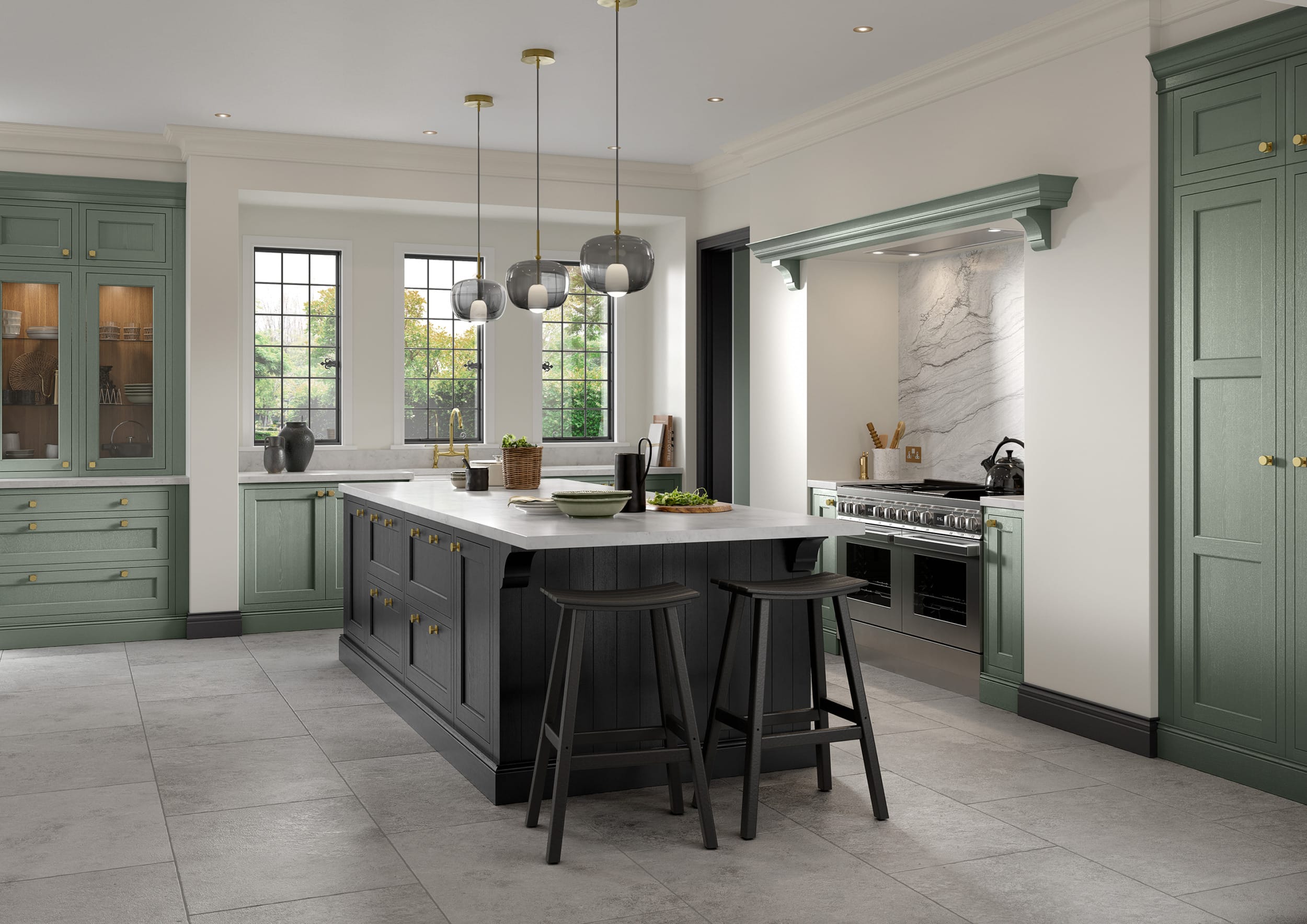
Over an island, pendant lights need to be hung at the right height. Too low and they obstruct the view across the kitchen; too high and they don’t do much for the worktop below. Around 700 to 750mm above the surface is a reasonable starting point, adjusted for the ceiling height and the scale of the fitting.
Sink and tap specification
A large sink is one of the most practical investments in a cooking kitchen. A single bowl that’s wide and deep enough to submerge a large stockpot or a roasting tray makes a real difference to how the kitchen functions day to day. Two smaller bowls can feel like a compromise if you’re regularly dealing with large cookware.
A boiling water tap is worth considering if you cook pasta, blanch vegetables, or make stock regularly. It removes the kettle from the worktop and speeds up tasks that would otherwise require waiting for a pan to come to the boil. The running cost is modest, and the worktop space it frees up is genuinely useful.
For the tap itself, a pull-out spray head makes rinsing large items and filling pots on the hob much easier. It’s a small detail, but one that gets used every day

How Mastercraft approaches this
When we design a kitchen for someone who cooks seriously, the brief starts with how they actually use the space. That means understanding what they cook, how often, whether they cook alone or with others, and what equipment they rely on. The layout follows from that, not from a standard template.
We think carefully about workflow – the sequence of tasks from fridge to prep to hob to table – and we design the storage, worktop runs, and appliance positions to support that sequence rather than interrupt it. Every decision, from drawer depth to extraction capacity to worktop material, is made with daily use in mind.
The result is a kitchen that performs consistently, not just one that looks good on the day it’s installed. That’s what bespoke design should deliver, and it’s the standard we hold every Mastercraft project to.
Start your Mastercraft design consultation
You'll work directly with a Mastercraft designer to plan a kitchen around your home, your layout and how you live day to day. From the first sketches through to technical planning and installation, everything is handled by one experienced in-house team.
Designed around your home
Every kitchen is made-to-measure for your room, your architecture and the way you use the space.
Technical survey included
We measure and plan everything before production begins so your kitchen fits exactly as intended.
Materials and samples
See door finishes, worktops and colours in your own home before making final decisions.

Browse the Mastercraft design library
Inside you'll find our brochures, design guides, material references and any current Mastercraft offers. A practical starting point if you're thinking about a kitchen but not ready to talk yet.
Explore more from Mastercraft Kitchens
If you’re planning a kitchen project, you can find out more about what we do across the north of England and beyond:
- fitted kitchens in Liverpool
- fitted kitchens in Manchester
- fitted kitchens in Harrogate
- fitted kitchens in Leeds
- fitted kitchens in Wirral
- bespoke kitchens in Yorkshire
If you’d like to talk through your project with one of our designers, we’re happy to arrange a consultation at a time that suits you.
Frequently asked questions
What size extractor hood do I need for a range cooker?
As a general rule, the hood should be at least as wide as the cooking surface and ideally wider, with an overhang of around 150mm on each side. For a 100cm range cooker, a 110cm or 120cm hood is a sensible starting point. Airflow capacity matters as much as size, so check the rated output in cubic metres per hour against the size of your kitchen.
Are deep drawers better than base cabinets for pan storage?
For most people who cook regularly, yes. Deep drawers let you see and reach everything without unpacking the cabinet, and they handle heavy pans more comfortably than shelves. A three-drawer stack with the deepest drawer at the bottom is a practical configuration for a cooking kitchen.
Is induction worth considering if I’ve always cooked on gas?
It’s worth thinking about seriously. Induction gives you very precise heat control, the surface stays relatively cool, and it’s straightforward to clean. The main practical consideration is that your existing cookware needs to be induction-compatible, which means it must have a magnetic base. Cast iron and most stainless steel pans work fine; copper and some aluminium pans don’t.
How much worktop space do I actually need for serious cooking?
There’s no single answer, but a clear run of at least 900mm to one side of the hob makes a significant difference for prep and plating. If you have an island, it should be large enough to serve as a genuine workspace rather than just a breakfast bar. Think about where you’ll rest hot pans, where you’ll plate up, and whether there’s a clear path between the hob and the sink.
What’s the most practical sink configuration for a cooking kitchen?
A single large bowl can be more useful than two smaller ones if you regularly deal with large pots, pans, or roasting trays. Look for a bowl that’s deep enough to submerge a stockpot and wide enough to lay a large chopping board across the top for rinsing. A pull-out spray tap makes filling pots and rinsing large items considerably easier.