More people are asking about raw materials in their kitchens. Concrete worktops, exposed steel, reclaimed timber, and unfinished stone are all appearing in serious design briefs, and for good reason. Used with care and proportion, they can give a kitchen a quality that polished surfaces alone rarely achieve.
What we mean by raw materials
The term gets used loosely, so it is worth being clear. Raw materials in a kitchen context tend to mean surfaces and elements that retain some visible evidence of their origin or manufacture. Honed concrete rather than polished quartz. Brushed or blackened steel rather than chrome. Reclaimed timber with its grain and history intact rather than a smooth engineered board.
These are not unfinished in the sense of being incomplete. They are finished to a point where the material itself does the work, rather than being coated, laminated, or polished into something more uniform. That distinction matters when you are specifying them for a space that gets used every day
Why these materials appeal in a kitchen
A kitchen that uses only smooth, sealed, and reflective surfaces can start to feel a little clinical over time. Raw materials introduce texture, weight, and a sense of permanence that softer finishes cannot replicate. Concrete has a density to it. Reclaimed timber carries warmth. Blackened steel reads as serious and considered rather than decorative.
There is also a practical argument. Many raw materials age in a way that works in their favour. A honed concrete worktop develops a patina. Reclaimed oak deepens in colour. These are not materials that show every scratch as a failure. They absorb use and look better for it, which suits a kitchen that is genuinely cooked in.
That said, the appeal needs to be weighed against real maintenance requirements. Concrete needs sealing and occasional re-sealing. Untreated steel will rust if it is near a sink or hob without proper protection. Knowing what you are committing to before you specify is part of making a good decision.
How to mix raw materials with cabinetry
The most common mistake is treating raw materials as a feature in isolation. A concrete worktop dropped into an otherwise standard kitchen rarely looks intentional. It looks like an afterthought.
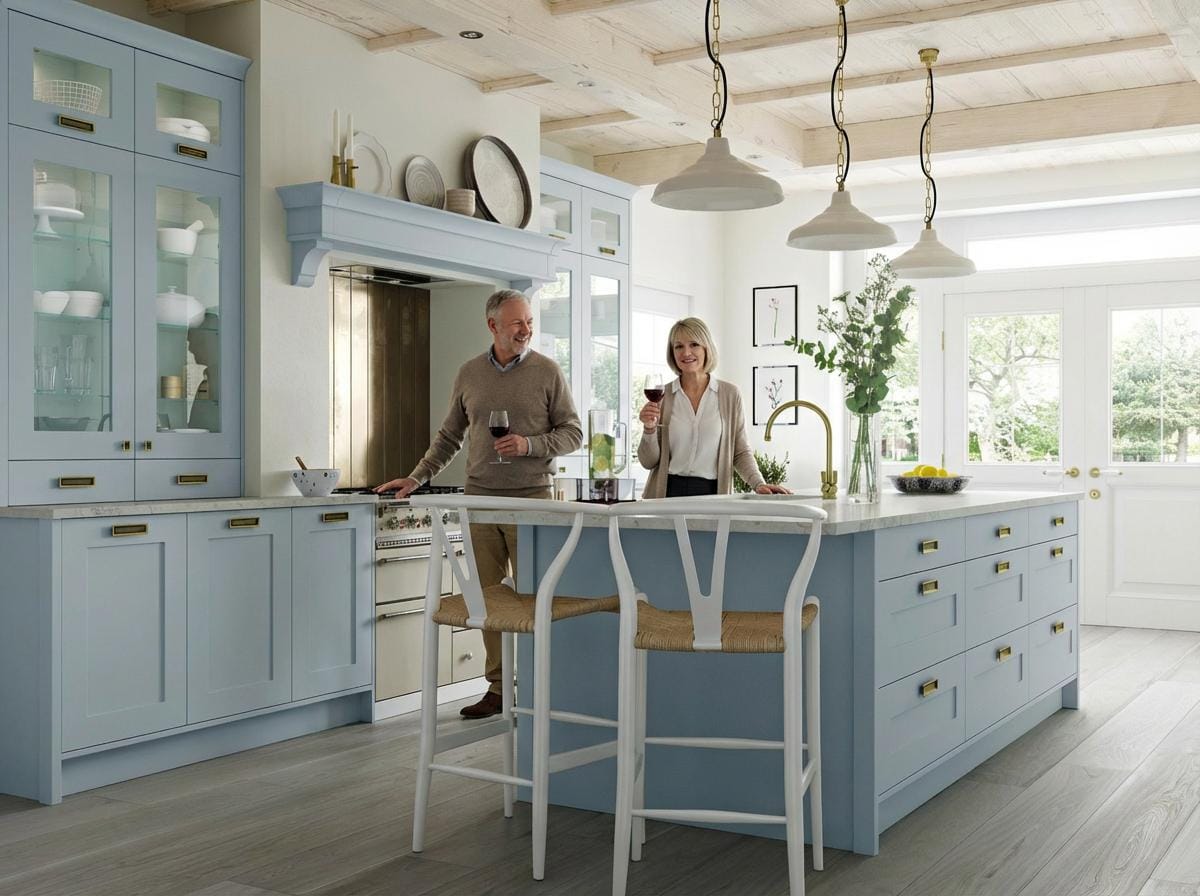
The better approach is to think about the material palette as a whole. If you are using a honed concrete worktop, consider how the cabinet colour and finish respond to it. A warm painted shaker door in an off-white or soft clay tone will sit comfortably alongside concrete. A high-gloss white door will fight it. The concrete will win, but not in a way that helps the room.
Steel works particularly well as a structural or functional element rather than a surface. Shelf brackets, a range hood, a larder frame, or a pot rail in brushed or blackened steel can anchor a kitchen without dominating it. The key is using it where it has a reason to be there, not applying it as a finish across large areas.
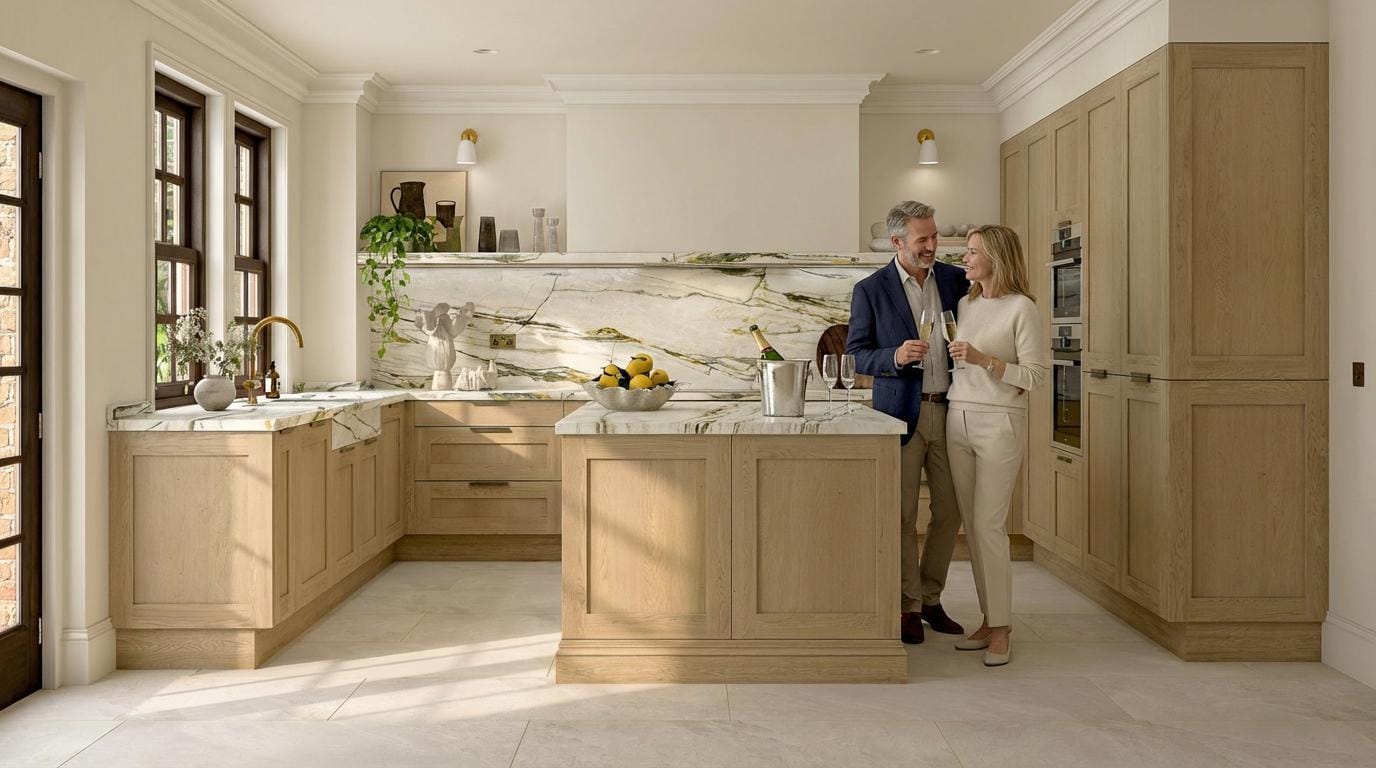
Reclaimed timber is perhaps the most forgiving of the three. It works on open shelving, as a breakfast bar overhang, or as a section of worktop in a lower-traffic area. Pairing it with painted cabinetry keeps the overall feel considered rather than rustic.
Proportion and placement
Raw materials need to be placed where they make sense structurally and visually. A full run of concrete worktop across a large kitchen can feel oppressive. The same material on an island, with a different worktop on the perimeter, gives the room contrast and lets each surface do its job.
Think about where your eye rests when you stand in the kitchen. If a raw material sits at the centre of that view, it needs to be worth looking at. If it is on a side return or a utility run, it can be more workmanlike. Placement should follow the logic of the room, not just the logic of the material.
Height matters too. Reclaimed timber at worktop height reads differently to the same timber used as a floating shelf at eye level. Steel at ceiling height in a pot rail feels light. Steel used as a full splashback panel behind a range can feel heavy unless the room has the scale to carry it

Practical considerations before you commit
Concrete worktops are heavy. Your carcasses and base units need to be built to carry the load, and the floor beneath them should be assessed if you are in an older property. This is not a reason to avoid concrete, but it is a reason to raise it early in the design process rather than late.
Sealing is not a one-time job. A good concrete worktop supplier will seal it before installation, but you should expect to reseal every year or two depending on use. Acidic liquids, including lemon juice and wine, can mark an unsealed surface quickly. If your kitchen sees heavy daily cooking, factor that into your decision.
Reclaimed timber used as a worktop surface needs to be properly treated for food contact areas. It also moves with humidity and temperature more than engineered materials, so it should not be used in sections that are tightly fitted between fixed elements without allowing for that movement. A good joiner will know this, but it is worth confirming.
Steel near water needs a finish that protects it. Blackened or patinated steel is not the same as stainless steel in terms of corrosion resistance. If you want the look of raw steel near a sink, discuss the finishing options with your fabricator and be honest about how wet that area gets.
Reversibility and long-term thinking
One question worth asking about any material choice is how easy it would be to change if your circumstances or preferences shift. This is not about doubting your decision. It is about designing a kitchen that has a sensible lifespan.
Raw materials tend to be more committed choices than painted cabinetry. You can repaint a door. You cannot easily replace a concrete worktop without significant disruption. That is not a problem if you are confident in the choice, but it does mean the decision deserves more thought than a colour selection.
The most adaptable approach is to use raw materials in elements that are structurally independent. An island with a concrete top can be replaced without touching the perimeter. Open shelving with reclaimed timber can be removed and replaced. A steel pot rail is a single fixing point. Thinking about which elements are fixed and which are freestanding gives you more flexibility over time

How Mastercraft approaches this
When a brief includes raw or industrial materials, we start by asking what the material is actually doing in the room. Is it providing texture, warmth, visual weight, or contrast? Once that is clear, we can position it correctly and make sure the rest of the design responds to it rather than competing with it.
We do not treat raw materials as a trend to be applied. We treat them as one part of a considered material palette. That means thinking carefully about how a concrete worktop sits alongside the cabinet colour, how the lighting will read across a textured surface, and whether the practical demands of the household are a good match for the maintenance requirements involved.
Every Mastercraft kitchen is designed around the specific room, the way you use your kitchen, and the materials that will serve you well over time. If raw materials are part of that answer, we will specify them properly and build them to last. If they are not the right fit, we will tell you that too.
Start your Mastercraft design consultation
You'll work directly with a Mastercraft designer to plan a kitchen around your home, your layout and how you live day to day. From the first sketches through to technical planning and installation, everything is handled by one experienced in-house team.
Designed around your home
Every kitchen is made-to-measure for your room, your architecture and the way you use the space.
Technical survey included
We measure and plan everything before production begins so your kitchen fits exactly as intended.
Materials and samples
See door finishes, worktops and colours in your own home before making final decisions.

Browse the Mastercraft design library
Inside you'll find our brochures, design guides, material references and any current Mastercraft offers. A practical starting point if you're thinking about a kitchen but not ready to talk yet.
Explore more from Mastercraft Kitchens
If you are planning a kitchen project and would like to see more of our work across the North of England and Yorkshire, you can explore our fitted kitchens in the following areas:
- fitted kitchens in Liverpool
- fitted kitchens in Manchester
- fitted kitchens in Harrogate
- fitted kitchens in Leeds
- fitted kitchens in Wirral
- bespoke kitchens in Yorkshire
If you are thinking about incorporating raw or industrial materials into your kitchen design and would like to talk it through with one of our designers, we would be glad to arrange a consultation at a time that suits you.
Frequently asked questions
Are concrete worktops practical for everyday use?
Yes, but they require more care than quartz or granite. Concrete worktops need to be properly sealed before use and resealed periodically. Acidic liquids can mark the surface if it is not well protected, so it is worth discussing the sealing specification with your supplier before committing.
Can I mix reclaimed timber with painted cabinetry in a bespoke kitchen?
Reclaimed timber works well alongside painted cabinetry, particularly on open shelving, a breakfast bar overhang, or a section of worktop in a lower-traffic area. The key is making sure the timber tone and the cabinet colour are chosen together rather than separately, so the overall palette feels deliberate.
Will blackened steel rust near a kitchen sink?
Blackened or patinated steel is not as corrosion-resistant as stainless steel, so placement near water needs careful thought. If you want the look of raw steel in a wet area, ask your fabricator about protective finishing options and be clear about how much water exposure that section will regularly see.
How heavy is a concrete worktop and will my units support it?
Concrete worktops are significantly heavier than quartz or laminate, and your base units need to be built to carry the load. In older properties it is also worth checking the floor structure beneath. Raise this early in the design process so the carcasses can be specified correctly from the start.
Is it possible to use raw materials in a kitchen without the whole room looking industrial?
Absolutely. The most effective approach is to use raw materials as one element within a broader palette rather than as the dominant theme. A concrete island top alongside painted shaker cabinetry and a warm timber shelf reads as considered and grounded rather than industrial. Proportion and placement do most of the work.